

Your enamel is losing minerals right now, and it will get some of them back over the next hour. That tug-of-war runs three to six times a day, every day of your life, and which side wins is largely up to you.
This guide covers what remineralization actually is, the nine habits that support it, how long it takes, and what it can't fix. It also covers the single biggest gap in most people's routine: the hours after eating, when enamel is most vulnerable and your toothbrush is nowhere near your mouth. That gap is exactly what NanoChew was built to close.
Quick Answer
Remineralization is the natural process of putting calcium and phosphate back into enamel after acid strips them out. You support it by limiting how often acid hits your teeth, brushing with a mineral toothpaste, and getting mineral plus saliva onto your teeth in the 30–60 minutes right after you eat. That last window is where most routines fail. Chewing 2–3 pieces of NanoChew a day, 20–30 minutes each after meals, delivers nano-hydroxyapatite, the mineral enamel is made of, exactly when your teeth are rebuilding.
Last updated: September 2026 · Research sourced from peer-reviewed literature and the American Dental Association
Key takeaways
- Enamel dissolves below about pH 5.5 and rebuilds when saliva brings the pH back up, over 30–60 minutes
- How often you eat matters more than how much: one cookie eaten in four sittings means about 160 minutes of acid exposure instead of 40
- Early white-spot damage can remineralize; a cavity through the surface cannot
- Hydroxyapatite has matched fluoride toothpaste for cavity prevention in clinical trials and beat it by about 23% for sensitivity
- Chewing raises saliva flow 10–12 times, and the ADA credits 20 minutes of sugar-free gum after meals with helping prevent decay
- NanoChew adds the mineral itself to that window: 2–3 pieces daily, $0.50 a piece
In this article
- What remineralization actually is
- The daily cycle, explained
- What it can and can't fix
- Signs you're losing minerals
- 9 ways to remineralize your teeth
- Hydroxyapatite vs fluoride
- The gap every routine has
- What's in NanoChew, and why
- How long it takes
- Myths that waste your time
- A daily routine that works
- When to see a dentist
- FAQ
- Sources
What remineralization actually is
Tooth enamel is roughly 97% hydroxyapatite, a crystalline calcium-phosphate mineral. It's the hardest substance in your body with one serious weakness: acid dissolves it.
When acid lowers the pH at the tooth surface, calcium and phosphate leach out of those crystals. That's demineralization. When the pH climbs back, ions move back into the crystal voids and rebuild the structure. That's remineralization.
Both happen every day. Healthy teeth are simply teeth where the rebuilding keeps pace with the stripping.
Here's the part most articles skip: your saliva can only deposit the minerals available to it. Supplying more of the right mineral, at the right moment, is the entire logic behind hydroxyapatite toothpaste and behind remineralizing gum.
The daily cycle, explained
Dentists chart this as the Stephan curve, and it explains nearly every recommendation in this article.
- You eat. Plaque bacteria ferment sugars and starches into acid within minutes.
- The pH crashes below roughly 5.5, the critical threshold where enamel begins dissolving.
- Minerals leave. While the pH stays down, your enamel is losing calcium and phosphate.
- Saliva recovers it over the next 30 to 60 minutes.
Acidic drinks skip step one and attack directly. In a study published in the Journal of the American Dental Association, researchers measured 380 beverages sold in US stores and found 93% had a pH below 4.0, squarely in the erosive range. Sugar-free soda counts. So do sports drinks, citrus juice and wine.
Frequency beats quantity. Every exposure starts a fresh 30–60 minute recovery. Dental educators put it this way: eat a cookie in a few minutes and your teeth spend about 40 minutes in the acid zone; eat the same cookie in four bites an hour apart and it's about 160 minutes. Same cookie, four times the damage.
Which means the highest-value minutes of your day, dentally speaking, are the ones right after you finish eating. Almost nobody does anything with them.
What remineralization can and can't fix
| Situation | Can remineralization help? |
|---|---|
| Early white-spot lesions, enamel surface intact | ✅ Yes, this is exactly what it's for |
| Daily acid softening after meals | ✅ Yes, every single day |
| Sensitivity from thinning enamel | ✅ Often, and usually the first thing people notice |
| A cavity that has broken the surface | ❌ No. That needs a filling |
| Enamel worn away entirely | ❌ No. Enamel doesn't regrow |
| Cracked or chipped teeth | ❌ No. See a dentist |
Any product promising to reverse a real cavity is overselling, and we won't. What a good daily routine does is win the cycle often enough that early damage never becomes a cavity.
Signs you're losing minerals
- White spots, especially near the gumline. The classic early lesion, and the best candidate for remineralization.
- Sensitivity to cold, heat or sweets, which points to thinning enamel or exposed dentin.
- Translucent edges on your front teeth, a common sign of acid erosion.
- Rough or dull patches where enamel once felt glassy.
- A more yellow look, as thinning enamel lets the dentin underneath show through.
If any of these sound familiar, start the routine below today and book a dental exam. Sensitivity in particular tends to respond quickly: in a double-blind study of 107 people, a hydroxyapatite chewing gum significantly improved every sensitivity measure within one to two weeks against an identical placebo gum. More on sensitive teeth here.
9 ways to remineralize your teeth
1. Cut how often acid hits your teeth
The highest-leverage change most people can make. Group snacks instead of grazing. Drink soda or juice with a meal rather than sipping it over two hours. Every separate exposure buys another 30–60 minutes in the danger zone.
2. Brush with a mineral toothpaste, morning and night
Hydroxyapatite or fluoride, both supply or attract what enamel needs. See the comparison below. This covers two minutes, twice a day.
3. Chew a remineralizing gum after every meal
This is the step that covers everything your toothpaste can't reach, and it's the one most routines are missing.
The ADA endorses the habit directly: chewing sugarless gum for 20 minutes after meals can help prevent tooth decay. Resting saliva flow is about 0.3–0.4 mL per minute, and chewing gum base alone raises it 10 to 12 times, with stimulated saliva carrying more calcium, phosphate and hydroxide, the exact building blocks of enamel.
Ordinary sugar-free gum gives you that saliva boost and nothing else. NanoChew adds nano-hydroxyapatite to it, so the window where your enamel is rebuilding has the finished mineral available, not just whatever your saliva can supply. Chew 2–3 pieces a day, 20–30 minutes each, right after meals. Here's the full comparison with regular gum.
4. Don't brush right after acidic foods
Acid temporarily softens enamel, and brushing softened enamel wears it down. The ADA recommends waiting about an hour after acidic food or drink. That hour isn't dead time: chew a piece of NanoChew instead, and you're boosting saliva and supplying mineral during the exact window you're not supposed to brush in.
5. Fix a dry mouth
Saliva is the remineralization system. If medication, mouth breathing or dehydration has reduced yours, the whole process slows and cavity risk climbs. Drink water through the day, talk to your dentist if it's persistent, and use chewing to stimulate flow, which is one of the simplest ways to get saliva moving on demand.
6. Eat for the minerals enamel is built from
Calcium and phosphate are the raw materials: dairy, leafy greens, almonds, eggs, fish, meat. Vitamin D governs how well you absorb calcium. Cheese is a useful way to end a meal because it's calcium-rich and stimulates saliva. Food alone won't remineralize a tooth, but a mineral-poor diet makes everything else harder.
7. Get xylitol into your routine
Xylitol is the most-studied sweetener in preventive dentistry. Cavity-causing Streptococcus mutans takes it up but can't metabolize it, which drains the bacterium rather than feeding it. A 2025 systematic review in BMC Oral Health found xylitol gum significantly lowered mutans streptococci counts in 12 of 14 studies versus sorbitol gum, reduced plaque accumulation in 6 of 10, and lowered caries occurrence in 3 of 5 trials.
The practical way to get it is gum, chewed after meals. NanoChew is sweetened with organic xylitol and organic erythritol, with no sugar and no aspartame.
8. Brush gently with a soft brush
Hard scrubbing wears enamel and pushes gums back, exposing root surfaces that have no enamel at all. Technique beats force, every time.
9. Keep your checkups
Early lesions are much easier to spot on an exam than in your bathroom mirror, and caught early they're the ones that respond to everything above.
Hydroxyapatite vs fluoride
Fluoride incorporates into the enamel surface to form fluorapatite, which resists acid better than the original mineral. Decades of evidence, endorsed by essentially every dental association.
Hydroxyapatite takes a different route: it is the mineral enamel is made of, so it supplies material directly. Nano-hydroxyapatite is produced at roughly the 20–40 nm scale of natural enamel crystals, small enough to settle into the microscopic defects acid leaves behind. Researchers call it biomimetic for that reason.
The evidence:
- A 2024 systematic review and meta-analysis in the Journal of Dentistry concluded hydroxyapatite is clinically non-inferior to fluoride toothpaste for caries prevention, drawing on randomized trials including an 18-month double-blind study in adults against 1,450 ppm fluoride.
- At UT Health San Antonio, 30 adults wore intraoral appliances holding enamel samples across 28-day phases. Formulas with 5% and 10% nano-hydroxyapatite and an 1,100 ppm fluoride toothpaste all significantly reduced mineral loss and lesion depth, with no significant difference in mineral gain among them.
- For sensitivity, a 2023 meta-analysis of 44 clinical trials found hydroxyapatite outperformed placebo by nearly 40% and fluoride toothpastes by about 23%.
- On safety, the EU's Scientific Committee on Consumer Safety reviewed nano-hydroxyapatite in 2025 and found no mutagenic, cytotoxic or inflammatory effects, with negligible uptake through the lining of the mouth. Japan has recognized hydroxyapatite as an anti-cavity agent since 1993.
You don't have to pick a side. Use whichever toothpaste you and your dentist prefer, and add hydroxyapatite where toothpaste can't go: the hours after meals. Full research summary here.
The gap every routine has
Add up a great oral care routine and you get about four minutes of coverage a day. Meanwhile your enamel runs three to six acid cycles, each lasting 30 to 60 minutes. That's two to six hours of vulnerability against four minutes of protection, and none of those four minutes land when it matters.
| Contact time | Timing | Supplies mineral? | |
|---|---|---|---|
| Brushing | 2 min, twice daily | Morning and night | ✅ |
| Mouthwash | 30–60 sec | Usually with brushing | Varies |
| Regular sugar-free gum | 20–30 min | After meals | ❌ saliva only |
| NanoChew | 20–30 min, 2–3× daily | Right after meals | ✅ nano-hydroxyapatite |
That's the case for gum in one table: it's the only format that puts mineral on your teeth during the window when they're actually rebuilding.
Close the gap — NanoChew, 60 pieces, $29.99 →
What's in NanoChew, and why
Every ingredient earns its place in the 20–30 minutes you're chewing.
- Nano-hydroxyapatite. The enamel mineral itself, with the clinical record above behind it, including the 107-person trial that tested it in gum form.
- Organic xylitol and organic erythritol. Xylitol's 12-of-14 result on mutans streptococci, plus erythritol's easy digestion. No sugar, no aspartame, zero calories.
- Natural propolis. The resin honeybees make from plant sources. A 2025 PROSPERO-registered meta-analysis of seven randomized controlled trials found propolis formulations significantly reduced plaque index scores, and a 2025 clinical trial tested propolis in chewing gum form, chewed 20 minutes three times daily after meals.
- Organic mastic gum. The resin of Pistacia lentiscus, with a Journal of Periodontology pilot study on the antiplaque effects of mastic chewing gum.
- Organic eggshell powder. A 2026 systematic review and meta-analysis in Odontology, covering 17 in vitro studies, found eggshell extract significantly improved enamel microhardness and reduced surface roughness, with results comparable to fluoride varnish and nano-hydroxyapatite.
- Bentonite clay, natural calcium, coconut oil and activated charcoal. Extra mineral content, a softer chew that lasts the full window, and a clean mouthfeel.
- Organic chicle base. Real tree resin, not the unnamed synthetic "gum base" on most labels.
Dentist-formulated, 500+ five-star reviews, 60 pieces for $29.99, which is $0.50 a piece. One pouch covers 20–30 days at the recommended amount. Every ingredient is published here.
How long does remineralization take?
| Timescale | What's happening |
|---|---|
| 30–60 minutes | One acid cycle recovers after a single meal. This is the window a piece of NanoChew covers. |
| 1–2 weeks | Sensitivity improved significantly in the hydroxyapatite gum trial |
| 4 weeks | Measurable mineral gain in controlled studies of early lesions |
| 3+ months | Where durable results come from. Two to four pouches of daily use. |
Consistency beats intensity. A perfect week followed by three sloppy ones nets out at zero, which is exactly why the habit needs to be something you'll actually keep doing after every meal.
Myths that waste your time
"You can heal a cavity at home." Early non-cavitated lesions can remineralize. Once decay breaks the surface, nothing reverses it. Waiting makes it bigger and more expensive.
"Enamel grows back." It doesn't. Remineralization refills mineral in a structure that's still standing. Worth doing, and not the same as regrowth.
"Oil pulling remineralizes teeth." It supplies no mineral. Whatever it does for plaque, it isn't remineralization.
"DIY remineralizing tooth powder." Homemade clay-and-calcium mixes have no dose control and can be abrasive enough to wear the enamel you're protecting. A dosed, tested formula is the point.
"Charcoal whitening rebuilds enamel." Abrasive whitening removes surface material. That's the opposite of the goal.
"Any sugar-free gum is the same." All sugar-free gum stimulates saliva. Only a remineralizing gum brings the mineral with it, and most drugstore gum is sweetened with sorbitol and aspartame in an unnamed synthetic base.
A daily routine that works
| When | What to do |
|---|---|
| Morning | Brush gently before breakfast. Chew 1 NanoChew after you eat, or after your coffee. |
| Midday | Chew 1 after lunch for 20–30 minutes, when brushing isn't an option. Keep acidic drinks with the meal. |
| Afternoon | Group snacks rather than grazing. Water in between. |
| Evening | Chew 1 after dinner. Skip brushing for an hour if the meal was acidic. |
| Night | Brush and floss. Nothing but water afterward. |
Three pieces, three meals, zero extra time out of your day. Keep a pouch wherever you finish eating: desk drawer, car, gym bag. Full timing guide here.
When to see a dentist
- A dark spot, hole or rough edge you can feel with your tongue
- Pain when biting down
- Sensitivity that lingers more than 30 seconds after the trigger
- White spots that are growing or spreading
- Swollen or bleeding gums
- Persistent dry mouth
Everything here supports your teeth between visits. None of it replaces an exam.
FAQ
Can you really remineralize your teeth?
Yes, for early damage. Calcium and phosphate can be redeposited into enamel that has lost mineral but is still intact. The practical question is whether your teeth get mineral and saliva in the 30–60 minutes after eating, which is what chewing NanoChew after meals is designed to deliver.
What's the best product to remineralize teeth?
A mineral toothpaste for morning and night, plus a remineralizing gum for the hours in between. NanoChew pairs nano-hydroxyapatite with organic xylitol, erythritol, propolis, mastic and eggshell powder, at $0.50 a piece. See how the brands compare.
How long does it take to remineralize teeth?
One acid cycle recovers in 30–60 minutes. Sensitivity improved within one to two weeks in the hydroxyapatite gum trial, controlled studies show mineral gain in early lesions over about four weeks, and durable change takes 3+ months of daily consistency.
Can you remineralize teeth without fluoride?
Yes. A 2024 meta-analysis found hydroxyapatite clinically non-inferior to fluoride toothpaste for cavity prevention, and NanoChew is fluoride-free.
Does chewing gum remineralize teeth?
Regular sugar-free gum boosts saliva 10–12 fold, and the ADA credits 20 minutes after meals with helping prevent decay. A remineralizing gum adds nano-hydroxyapatite to that, so you're not relying on saliva alone. Full comparison.
Do white spots go away?
Early ones can improve with consistent mineral support. Established spots may need professional treatment, so have them looked at.
What foods remineralize teeth?
No food does it alone, but calcium, phosphate and vitamin D supply the raw materials: dairy, cheese, leafy greens, almonds, eggs and fish. Cheese after a meal helps twice over, since it also stimulates saliva.
Should I brush right after eating?
Not after anything acidic. The ADA recommends waiting about an hour. Chew a piece of NanoChew during that hour instead.
Can remineralization reverse a cavity?
No. It reverses early, non-cavitated mineral loss. A cavity through the enamel surface needs a filling.
Is nano-hydroxyapatite safe?
Yes. The EU's Scientific Committee on Consumer Safety reviewed it in 2025 and found no mutagenic, cytotoxic or inflammatory effects. Japan has recognized hydroxyapatite as an anti-cavity agent since 1993. Full breakdown.
How many pieces of NanoChew should I chew a day?
2–3, after meals, 20–30 minutes each. A 60-piece pouch covers 20–30 days.
Bottom line
Remineralization isn't a hack. It's a process your mouth runs several times a day, and your job is to tip the balance: fewer acid events, no brushing on softened enamel, and mineral on your teeth during the hour they're rebuilding.
Your toothbrush covers four minutes. NanoChew covers the hours that actually decide it.
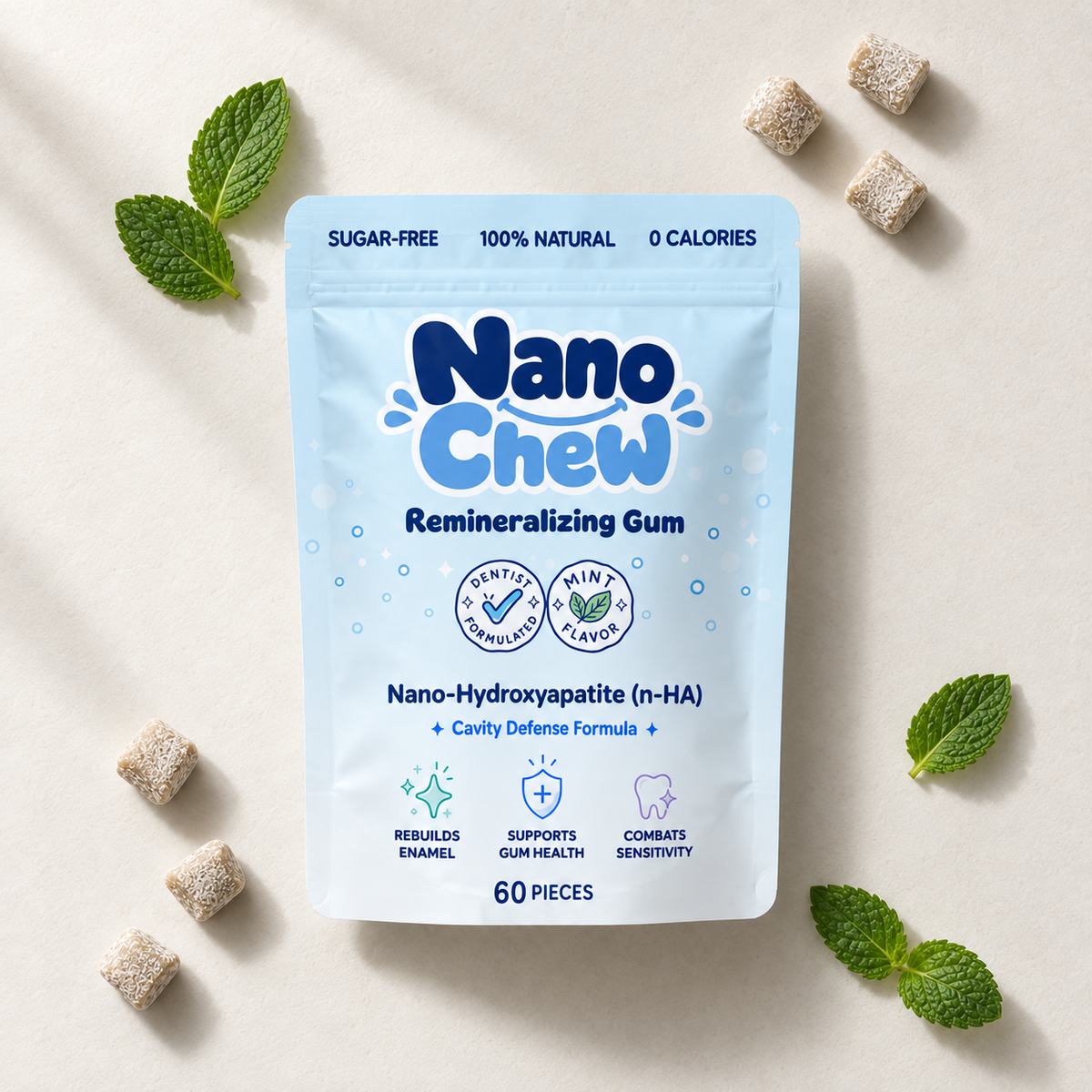
Shop NanoChew — 60 pieces, $29.99 →
These statements have not been evaluated by the FDA. NanoChew is not intended to diagnose, treat, cure, or prevent any disease and is not a substitute for regular dental care.
Sources
- American Dental Association. "Chewing Gum." Oral Health Topics. ada.org
- American Dental Association, MouthHealthy. "Dietary Acids and Your Teeth." mouthhealthy.org
- Dentalcare.com. "Stephan Curve," Caries Process, Prevention and Management continuing-education course. dentalcare.com
- Reddy A, Norris DF, Momeni SS, Waldo B, Ruby JD. "The pH of beverages in the United States." J Am Dent Assoc. 2016;147(4):255–263. PMC
- Pawinska M, Paszynska E, Amaechi BT, et al. "Clinical evidence of caries prevention by hydroxyapatite: an updated systematic review and meta-analysis." J Dent. 2024;151. ScienceDirect
- Paszynska E, Pawinska M, Enax J, et al. "Caries-preventing effect of a hydroxyapatite-toothpaste in adults: an 18-month double-blinded randomized clinical trial." Front Public Health. 2023;11:1199728. doi:10.3389/fpubh.2023.1199728
- Najibfard K, Ramalingam K, Chedjieu I, Amaechi BT. "Remineralization of early caries by a nano-hydroxyapatite dentifrice." J Clin Dent. 2011;22(5):139–143. PubMed
- Limeback H, Enax J, Meyer F. "Clinical evidence of biomimetic hydroxyapatite in oral care products for reducing dentin hypersensitivity: an updated systematic review and meta-analysis." Biomimetics. 2023;8(1):23. doi:10.3390/biomimetics8010023
- Porciani PF, Chazine M, Grandini S. "A clinical study of the efficacy of a new chewing gum containing calcium hydroxyapatite in reducing dentin hypersensitivity." J Clin Dent. 2014;25(2):32–36. PubMed
- Söderling E, Pienihäkkinen K. "Specific effects of xylitol chewing gum on mutans streptococci levels, plaque accumulation and caries occurrence: a systematic review." BMC Oral Health. 2025;25:1275. doi:10.1186/s12903-025-06602-1
- Sycińska-Dziarnowska M, Szyszka-Sommerfeld L, Bugajska M, et al. "Propolis as a natural remedy in reducing dental plaque and gingival inflammation: a systematic review and meta-analysis." J Funct Biomater. 2025;16(9):336. doi:10.3390/jfb16090336
- Khabazian A, Mirhashemi FS, Sadeghi F. "Investigating the effect of propolis-containing chewing gum in comparison with propolis-containing mouthwash on reducing gingival inflammation in patients with gingivitis." BMC Oral Health. 2025;25:231. doi:10.1186/s12903-025-05564-8
- "In vitro remineralization effectiveness of eggshell extract on human teeth: a systematic review and meta-analysis." Odontology. 2026;114(3):1057–1068. PubMed
- Takahashi K, Fukazawa M, Motohira H, et al. "A pilot study on antiplaque effects of mastic chewing gum in the oral cavity." J Periodontol. 2003;74:501–505. PubMed
- Dimensions of Dental Hygiene. "The Role of Nutrition in Dental Caries." 2024. dimensionsofdentalhygiene.com
- European Commission, Scientific Committee on Consumer Safety. "Scientific Opinion on Hydroxyapatite (nano), Submission IV." SCCS/1677/25, 2025. European Commission