
Quick Answer
Yes. Nano-hydroxyapatite is the same calcium-phosphate mineral your enamel is made of. Europe's independent scientific committee has reviewed it repeatedly, most recently in 2025, and found no mutagenic, cytotoxic or inflammatory effects, with negligible uptake through the lining of the mouth. Japan recognized hydroxyapatite as an anti-cavity agent back in 1993. NanoChew puts that mineral to work in a sugar-free, aspartame-free gum.
Last updated: September 2026
Key takeaways
- Nano-hydroxyapatite is not a synthetic chemical. It's the mineral that makes up roughly 97% of enamel
- The EU's scientific committee has assessed it three times since 2015 and raised its approved limits as more data arrived
- Its 2025 opinion found no genetic, cell or inflammatory toxicity, even at high test concentrations
- It has been used in oral care in Japan for decades
- Shape and coating matter, which is why regulators specify the particle type they approved
Here's the idea behind an entire new category of oral care: your enamel loses minerals every time you eat, and the fastest way to put them back is to deliver the mineral itself during the window right after a meal. That's what a remineralizing gum does. Instead of just freshening your breath, it carries nano-hydroxyapatite, the mineral enamel is made of, onto your teeth while you chew.
New categories invite fair questions, and "nano" invites the biggest one. Is it safe to chew this every day?
We're NanoChew. We make a sugar-free, dentist-formulated remineralizing gum built on nano-hydroxyapatite, and our customers chew it 2–3 times a day, every day. A product used that often should be able to show its work. So below is what regulators and researchers have actually found, with every source linked, followed by how gum became the delivery format and what's in ours.
In this article
- What nano-hydroxyapatite actually is
- Why people ask about "nano"
- What Europe's regulators found
- Why particle shape matters
- What about swallowing it?
- Decades of real-world use
- Nano-hydroxyapatite in chewing gum
- What this means for the gum you chew daily
- Why people choose NanoChew
- How to judge any brand's safety claims
- FAQ
- Sources
What nano-hydroxyapatite actually is
Start here, because the name does the ingredient no favors.
Hydroxyapatite is a calcium-phosphate mineral, and it makes up roughly 97% of your tooth enamel. It's also a major component of your bones. It isn't foreign to your body; it is your body.
Natural enamel is built from hydroxyapatite nanoparticles around 20–40 nm in size. Nano-hydroxyapatite (n-HA) is that same mineral, made in particles of a similar scale, which is why researchers call it biomimetic: it mimics what your teeth already are. See how NanoChew uses it.
Why people ask about "nano"
It's a fair question. "Nano" has become shorthand for something new and untested, and people reasonably want to know whether tiny particles get absorbed into the body.
Regulators asked exactly the same thing. The European Union has some of the strictest cosmetic ingredient rules anywhere, and it put nano-hydroxyapatite through repeated independent review rather than taking manufacturers' word for it. That's why there's a real answer to this question instead of just marketing reassurance.
What Europe's regulators found
The Scientific Committee on Consumer Safety (SCCS) is the independent body that evaluates cosmetic ingredients for the European Commission. Hydroxyapatite has been assessed in 2015, 2021, 2023 and again in 2025. Here's how the conclusions moved:
| When | What happened |
|---|---|
| March 2023 | SCCS concluded nano-hydroxyapatite is safe up to 10% in toothpaste and 0.465% in mouthwash, for a specific particle type |
| March 2024 | The EU wrote those limits into law under Regulation 2024/858, authorizing n-HA for toothpaste and mouthwash and barring it from anything inhalable |
| 2025 | After new safety data, SCCS raised the limits substantially, to 29.5% in toothpaste and 10% in mouthwash |
That last step is the part worth sitting with. Regulators don't raise a limit on an ingredient they're worried about. The 2025 opinion found that nano-hydroxyapatite poses no mutagenic hazard and causes no cytotoxicity or inflammatory effects, even at high concentrations tested on a model of the cells lining the mouth. It also concluded that uptake through the oral lining is negligible, and that cells taking up any particles are naturally shed and replaced over time.
The Netherlands' National Institute for Public Health and the Environment put it plainly: the new data confirmed that nano-hydroxyapatite doesn't cause genetic mutations, cytotoxicity or inflammation, and isn't significantly taken up by cells.
Why particle shape matters
One detail separates informed buyers from the rest. The EU's approval applies to a specific particle type: rod-shaped particles that are not coated or surface-modified, with tight limits on how elongated they can be. Needle-shaped or coated particles weren't part of that assessment.
That's a reasonable approach, not a red flag. Shape influences how a particle behaves, so regulators approved what they tested. It's also a good question to ask any oral care brand: what form of hydroxyapatite are you using?
What about swallowing it?
This comes up most often with kids and with anyone who doesn't love spitting out toothpaste. Two things to know.
First, the EU's review assessed oral care products under realistic conditions of use, which includes the reality that some toothpaste gets swallowed. Second, gum is a different situation entirely: you chew NanoChew for 20–30 minutes and then throw it away. It's never meant to be swallowed, the way no gum is.
Decades of real-world use
Nano-hydroxyapatite isn't a 2020s wellness launch. Its oral-care story starts with a NASA patent that Japanese company Sangi acquired in the 1970s, followed by years of laboratory research and field trials in Japanese primary schools.
Japan's government formally recognized hydroxyapatite as an anti-cavity agent in 1993. Hydroxyapatite oral care has since spread to South Korea, Europe and beyond, and one Japanese manufacturer alone has shipped more than 150 million tubes.
So the long-term safety record here isn't theoretical. It's decades of daily use across entire countries.
Nano-hydroxyapatite in chewing gum: why the format works
Most hydroxyapatite research has been done on toothpaste, because that's where the ingredient started. But toothpaste has a built-in limitation: it shows up twice a day for about two minutes, and neither of those times is after lunch.
Gum solves a different problem. Three things make it a strong delivery vehicle for a mineral:
- It arrives at the right moment. Enamel is most vulnerable in the 30 to 60 minutes after eating, when acids are pulling minerals out. That's precisely when a piece of gum is in your mouth.
- It stays put far longer. Brushing gives you two minutes of contact. A piece of gum keeps the mineral against your teeth for 20 to 30 minutes.
- It brings your own saliva into it. Chewing raises saliva flow 10 to 12 times over resting levels, and stimulated saliva carries more calcium and phosphate, the same building blocks as hydroxyapatite. The ADA credits chewing sugarless gum for 20 minutes after meals with helping prevent tooth decay on exactly that basis.
What the research shows for hydroxyapatite in gum
The ingredient evidence is strong on its own. A 2024 systematic review and meta-analysis found hydroxyapatite clinically non-inferior to fluoride toothpaste for cavity prevention, and a 2023 meta-analysis of 44 trials found it beat placebo by nearly 40% for tooth sensitivity.
The gum format has its own trial. In a double-blind study of 107 people, one group chewed a sugar-free gum containing hydroxyapatite and the other chewed an identical placebo gum. The hydroxyapatite group showed statistically significant improvement across every sensitivity measure after one and two weeks, and did significantly better than the placebo group.
In other words: this isn't toothpaste science borrowed to sell a candy. The mineral has been tested in the format, and it held up. See the full research summary.
What this means for the gum you chew every day
All of the above is about the ingredient. A daily habit product has to clear a second bar: everything else in the piece has to hold up too, because you're chewing it three times a day for months.
That's the standard we built NanoChew to. Here's the full picture of what's in each piece:
- Organic xylitol and organic erythritol. Tooth-friendly sweeteners with no sugar and no aspartame. Very large amounts of sugar alcohols can upset your stomach: in one controlled study, digestive effects showed up at single doses of 35–50 grams of xylitol, while erythritol was far better tolerated. At 2–3 pieces a day you're nowhere near that territory.
- Organic chicle and organic mastic. Natural tree resins used for centuries, instead of an unnamed synthetic gum base.
- Supporting ingredients: propolis, coconut oil, natural calcium, bentonite clay, activated charcoal and organic eggshell powder. All published, all on the ingredients page.
- One warning worth repeating: xylitol is safe for people but toxic to dogs, according to the FDA. Keep your pouch out of their reach.
Why people choose NanoChew
Safety is the floor, not the reason to buy. Here's the rest of it:
- Nano-hydroxyapatite in every piece, delivered right after meals when your enamel is recovering from acid.
- Dentist-formulated, with 500+ five-star reviews from people chewing it daily.
- No sugar, no aspartame, zero calories, sweetened with organic xylitol and organic erythritol.
- An organic chicle-and-mastic base, named on the label, with no plastic or synthetic resins.
- A spearmint chew people stick with: softer and longer-lasting, without the chalkiness some mineral gums have.
- 60 pieces for $29.99, which is $0.50 a piece, or $0.45 on Subscribe & Save. One pouch covers 20–30 days.
Try NanoChew — 60 pieces, $29.99 →
How to judge any brand's safety claims
- Is the full ingredient list published? If you can't see everything in it, you can't judge it.
- Is nano-hydroxyapatite named on the label, not just in the headline?
- Is the gum base identified? "Gum base" tells you nothing about what you're chewing for 30 minutes a day.
- Are safety claims sourced? A brand citing a regulator or a published study is telling you something. A brand citing itself isn't.
- Does it avoid what you want to avoid? Sugar, aspartame, artificial colors.
NanoChew publishes every ingredient, names its gum base, and links every study behind its claims. See how it compares to the rest of the category.
Shop NanoChew — 60 pieces, $29.99 →
FAQ
Is nano-hydroxyapatite safe?
Yes. The EU's Scientific Committee on Consumer Safety has reviewed it repeatedly and, in 2025, found no mutagenic, cytotoxic or inflammatory effects, with negligible uptake through the lining of the mouth. It's the same mineral your enamel is made of.
Is nano-hydroxyapatite toxic?
No. High test concentrations on a model of the cells lining the mouth produced no cytotoxicity or inflammation in the EU's 2025 assessment.
Is it banned anywhere?
No. The EU regulates it rather than banning it: authorized for oral care within set limits and particle characteristics, and not permitted in products that could be inhaled. Japan has recognized hydroxyapatite as an anti-cavity agent since 1993.
Is nano-hydroxyapatite safe to swallow?
The EU assessed oral care products under realistic use conditions, including incidental swallowing. NanoChew is gum, so you chew it for 20–30 minutes and throw it away.
Is nano-hydroxyapatite better than fluoride?
For cavity prevention, clinical trials have found hydroxyapatite toothpaste non-inferior to fluoride toothpaste. For sensitivity, a 2023 meta-analysis found it outperformed fluoride toothpastes by about 23%. You don't have to choose: NanoChew works alongside whatever toothpaste you use. Read the research.
Is NanoChew safe to chew every day?
It's designed for daily use: 2–3 pieces a day after meals, 20–30 minutes each. See the full routine.
Can kids chew it?
Gum isn't recommended for young children because of the choking risk. For older kids and teens, check with your dentist first.
Can I chew it while pregnant?
Run any new daily product by your dentist or doctor first.
Can I chew it with braces or dental work?
Ask your dentist or orthodontist. The ADA also advises people with TMJ disorders to avoid chewing gum.
Is it safe for pets?
No. NanoChew contains xylitol, which is toxic to dogs even in small amounts. Store it out of reach and call your vet immediately if your dog eats any.
Does it contain aspartame or sugar?
Neither. It's sweetened with organic xylitol and organic erythritol, with zero calories.
The mineral your teeth already trust
Reviewed by European regulators, used in Japan for decades, and the same material your enamel is built from. NanoChew delivers it after every meal, in a sugar-free, aspartame-free spearmint chew.
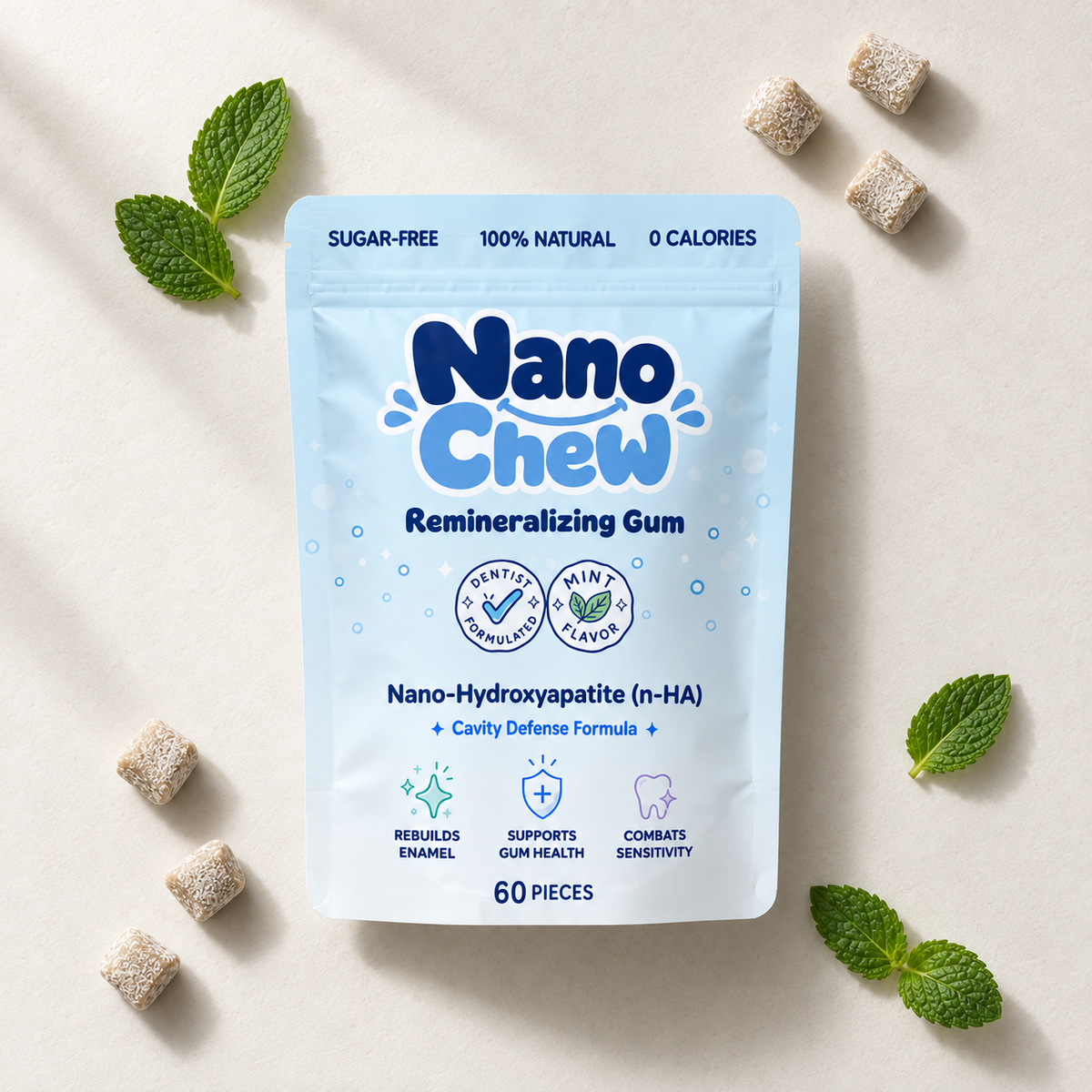
These statements have not been evaluated by the FDA. NanoChew is not intended to diagnose, treat, cure, or prevent any disease and is not a substitute for regular dental care.
Sources
- European Commission, Scientific Committee on Consumer Safety. "Scientific Opinion on Hydroxyapatite (nano), Submission IV." SCCS/1677/25, 2025. European Commission
- European Commission. "Commission Regulation (EU) 2024/858 of 14 March 2024." Official Journal of the European Union. EUR-Lex
- RIVM (National Institute for Public Health and the Environment, Netherlands). "New safety data confirms hydroxyapatite in nanoform is safe for oral care products." 2025. rivm.nl
- O'Hagan-Wong K, Enax J, Meyer F, Ganss B. "The use of hydroxyapatite toothpaste to prevent dental caries." Odontology. 2022;110:223–230. PMC
- Pawinska M, Paszynska E, Amaechi BT, et al. "Clinical evidence of caries prevention by hydroxyapatite: an updated systematic review and meta-analysis." J Dent. 2024;151. ScienceDirect
- Limeback H, Enax J, Meyer F. "Clinical evidence of biomimetic hydroxyapatite in oral care products for reducing dentin hypersensitivity: an updated systematic review and meta-analysis." Biomimetics. 2023;8(1):23. doi:10.3390/biomimetics8010023
- Sangi Co., Ltd. "Pioneering Technology." sangi-eu.com
- NASA Spinoff. "Semiconductor Research Leads to Revolution in Dental Care." spinoff.nasa.gov
- Storey D, Lee A, Bornet F, Brouns F. "Gastrointestinal tolerance of erythritol and xylitol ingested in a liquid." Randomized, double-blind, placebo-controlled study. Maastricht University
- U.S. Food and Drug Administration. "Paws Off Xylitol; It's Dangerous for Dogs." fda.gov
- American Dental Association, MouthHealthy. "Chewing Gum." mouthhealthy.org