
You take one sip of ice water and a jolt shoots through a tooth. Or the first mouthful of hot coffee does it. Or something sweet. It passes in a second, but you start bracing for it, and eventually you're drinking everything lukewarm.
Sensitivity like that usually starts at the enamel surface, which means the fix usually involves putting mineral back. That's the idea behind a category of oral care that barely existed a few years ago: remineralizing gum. Instead of just freshening your breath, it carries nano-hydroxyapatite, the mineral your enamel is made of, onto your teeth while you chew, during the window right after meals when enamel is most vulnerable.
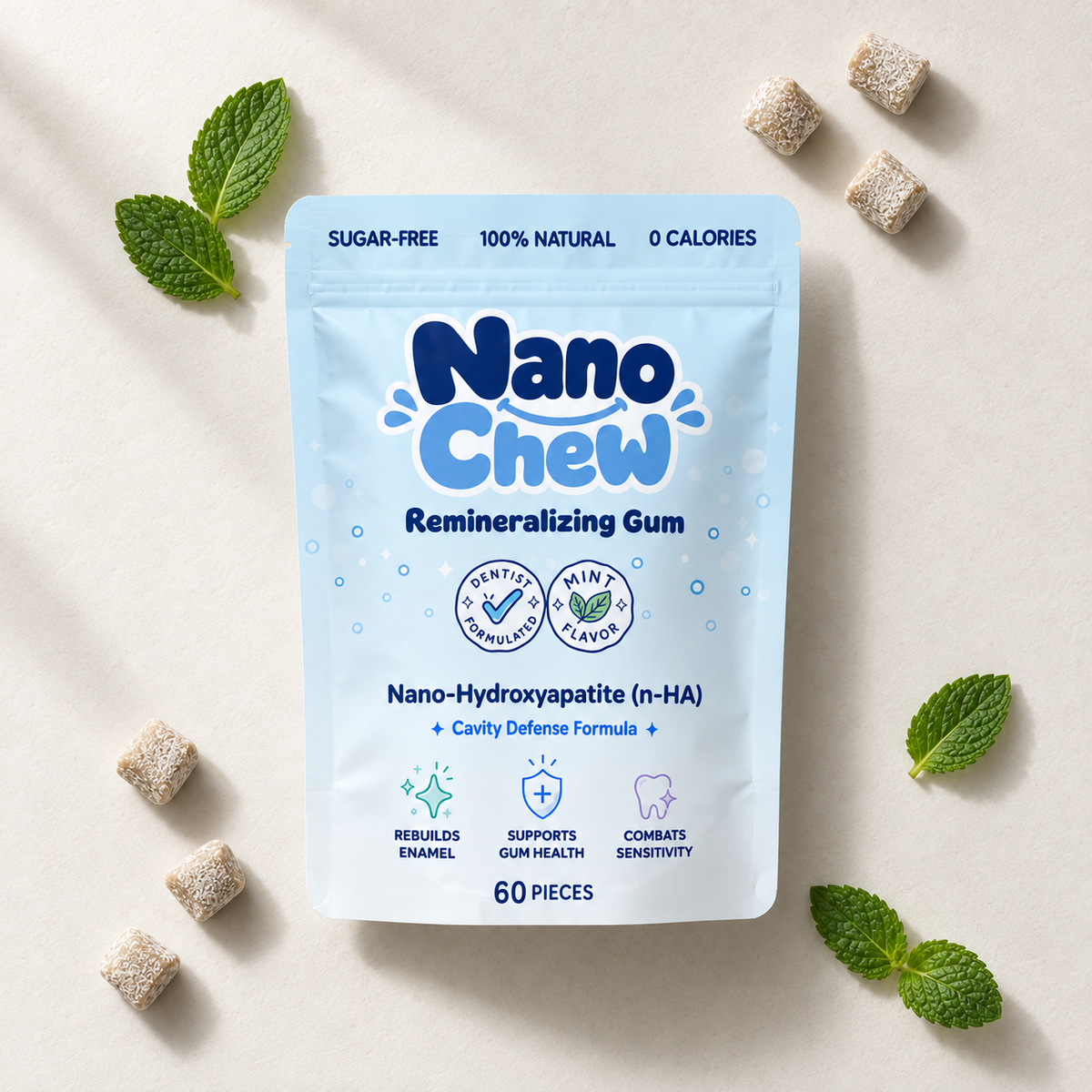
We're NanoChew. We make a sugar-free, dentist-formulated remineralizing gum built on nano-hydroxyapatite. Below is what actually causes sensitivity, what the clinical research shows about hydroxyapatite (including the one trial that tested it in gum form), and how to build a daily routine around it.
Quick Answer
Hydroxyapatite is one of the best-researched ingredients for sensitive teeth. A meta-analysis of 44 clinical trials found it outperformed placebo by nearly 40% and fluoride toothpaste by about 23%, and a double-blind study of 107 people found a hydroxyapatite gum significantly reduced sensitivity within one to two weeks. Chew 2–3 pieces of NanoChew a day after meals, 20–30 minutes each.
Last updated: September 2026
Key takeaways
- Sensitivity happens when worn enamel exposes dentin, which carries sensations straight to the nerve
- Hydroxyapatite helps by supporting the enamel surface and blocking the open channels in exposed dentin
- Clinical studies report relief within one to four weeks
- Gum keeps that mineral on your teeth for 20–30 minutes, far longer than brushing's two
- Sudden, severe or single-tooth pain needs a dentist, not a new routine
In this article
- Why teeth become sensitive
- The most common causes
- How hydroxyapatite helps
- What the research shows
- Why gum is a smart format
- Sensitivity after whitening
- Everyday triggers to watch
- Why people choose NanoChew
- A sensitivity-friendly routine
- When to see your dentist
- FAQ
- Sources
Why teeth become sensitive
Under your enamel sits a layer called dentin, and dentin is full of microscopic channels called dentinal tubules that lead toward the nerve. While enamel is intact, those channels stay sealed off from the outside world.
When enamel thins or wears, or when gums recede and expose root surfaces, the tubules open up. Hot, cold, sweet and even a blast of cold air can then move fluid inside those channels, and your nerve reads that movement as a jolt of pain.
That's why the answer to sensitivity is usually the same as the answer to weakened enamel: more mineral, in the right places, consistently.
The most common causes of sensitive teeth
- Acid wear. Soda, citrus, sports drinks, wine and coffee soften and thin enamel over time.
- Brushing too hard. Aggressive scrubbing, especially with a hard-bristled brush, wears enamel and irritates gums.
- Gum recession. Receding gums expose root surfaces, which have no enamel covering them at all.
- Grinding and clenching. This wears down chewing surfaces and can create micro-cracks.
- Whitening treatments. Peroxide-based whitening commonly causes temporary sensitivity.
- Cavities, cracks and dental work. These cause sensitivity too, and they need a dentist.
A remineralizing gum is built for the first few: the everyday acid-and-wear kind. It can't fix a cavity or a cracked tooth, and no honest brand will tell you otherwise.
How hydroxyapatite helps sensitive teeth
Hydroxyapatite is the calcium-phosphate mineral that makes up roughly 97% of your enamel. Nano-hydroxyapatite (n-HA) is that same mineral in particles sized like the ones natural enamel is built from, around 20–40 nm.
It works on sensitivity two ways:
- It supports the enamel surface with the same material your teeth are made of.
- It helps block exposed dentinal tubules. Lab studies show hydroxyapatite occluding the open channels that let sensations reach the nerve. Research on whitening products describes the same mechanism: blocking tubules limits fluid movement inside them, which reduces the pain signal.
That's a different approach from potassium-based sensitivity toothpastes, which work by calming the nerve rather than rebuilding mineral at the surface.
What the research shows
A 44-trial meta-analysis. In 2023, researchers pooled the clinical evidence on hydroxyapatite and dentin hypersensitivity. Across the randomized trials, it outperformed placebo by nearly 40% and fluoride toothpastes by about 23%, and it beat most other desensitizing formulas, including ones designed specifically to plug dentinal tubules.
A 105-person toothpaste trial. In a double-blind randomized trial, 105 people were split between nano-hydroxyapatite toothpaste, fluoride toothpaste and a placebo. The researchers concluded that n-HA was an effective desensitizing agent, giving relief at both the two-week and four-week checks.
A gum-specific trial. In a double-blind study of 107 people, one group chewed a sugar-free gum containing hydroxyapatite and the other chewed an identical placebo gum. The hydroxyapatite group showed statistically significant improvement in every sensitivity measure after one and two weeks, and did significantly better than the placebo group.
That last study is the one that matters most here. It shows the mineral works for sensitivity when it's delivered in a gum, not only in toothpaste.
Why gum is a smart format for sensitive teeth
- Contact time. Brushing gives you about two minutes. A piece of gum keeps mineral against your teeth for 20–30 minutes.
- Timing. Sensitivity flares after acidic meals and drinks. Chewing right afterward delivers support at that exact moment.
- Saliva. Chewing raises saliva flow 10–12 times over resting levels, and stimulated saliva carries more calcium and phosphate. The ADA credits chewing sugar-free gum for 20 minutes after meals with helping prevent tooth decay on that basis.
- No extra effort. It fits into a day you're already having, instead of adding another step at the bathroom sink.
Sensitivity after whitening
Whitening is one of the most common causes of short-term sensitivity, and hydroxyapatite has been studied specifically for it.
In a randomized clinical trial of 42 participants using a hydrogen peroxide whitening gel, a nano-hydroxyapatite paste shortened how long the whitening-related sensitivity lasted. In a separate 9-month randomized trial, a whitening gel that included nano-hydroxyapatite caused less sensitivity during treatment than one without it, with no loss of whitening results.
If you whiten, a daily mineral habit through the process makes sense: NanoChew after meals, and a hydroxyapatite toothpaste morning and night.
Everyday triggers to watch
Acidic drinks are the big one. In a study published in the Journal of the American Dental Association, researchers tested 380 beverages sold in US stores and found 93% had a pH below 4.0, putting them in the erosive range. Soda, sports drinks, citrus juice and wine all qualify, sugar-free versions included.
Three habits that help:
- Keep acidic drinks to mealtimes instead of sipping all day. Every sip restarts the acid clock.
- Don't brush immediately afterward. The ADA recommends waiting about an hour after acidic foods, since acid temporarily softens enamel.
- Chew a piece of NanoChew during that hour to boost saliva and deliver mineral support while you wait. See the full timing guide.
Why people choose NanoChew
Plenty of products put hydroxyapatite on a label. Here's what's in each piece of ours, and why people stay with it:
- Nano-hydroxyapatite in every piece, delivered right after meals, when sensitive teeth take the most acid.
- Dentist-formulated, with 500+ five-star reviews from people chewing it daily.
- Organic xylitol and organic erythritol. No sugar, no aspartame, zero calories.
- An organic chicle-and-mastic base, named on the label, instead of unspecified synthetic gum base.
- A supporting formula of propolis, coconut oil, natural calcium, bentonite clay and activated charcoal. Every ingredient is published.
- A chew people stick with: softer spearmint that lasts, without the chalkiness some mineral gums have.
- 60 pieces for $29.99, which is $0.50 a piece. One pouch covers 20–30 days.
Try NanoChew — 60 pieces, $29.99 →
A sensitivity-friendly routine
| When | What to do |
|---|---|
| Morning | Brush gently with a soft-bristled brush, ideally before breakfast. Chew 1 piece of NanoChew after you eat. |
| Midday | Chew 1 piece after lunch, especially if it included something acidic. |
| Evening | Chew 1 piece after dinner. |
| Night | Brush and floss. If you grind your teeth, ask your dentist about a night guard. |
What to expect: clinical studies on hydroxyapatite gum and toothpaste report improvement at the two-week and four-week marks. Keep the habit going for 3+ months for the best results. Sensitivity that developed over years won't reverse in a weekend.
When to see your dentist
Book an appointment if:
- The pain is sudden, severe, or focused on one tooth
- It hurts when you bite down
- Sensitivity lingers more than 30 seconds after the trigger is gone
- You see a chip, crack, dark spot or swollen gums
- It keeps getting worse despite a good routine
Those can signal a cavity, a cracked tooth, an infection or gum disease. NanoChew supports everyday sensitive teeth. It doesn't replace professional care.
FAQ
What is the best gum for sensitive teeth?
A sugar-free gum with hydroxyapatite, the ingredient with a double-blind clinical study behind it in gum form. NanoChew pairs nano-hydroxyapatite with organic xylitol and erythritol in an organic chicle-and-mastic base, 60 pieces for $29.99. Start with one pouch.
How fast does hydroxyapatite work for sensitivity?
Clinical studies report significant improvement at one to two weeks with a hydroxyapatite gum, and at two and four weeks with n-HA toothpaste. Keep the habit up for lasting results.
Is hydroxyapatite better than fluoride for sensitive teeth?
In a 2023 meta-analysis, hydroxyapatite outperformed fluoride toothpastes by about 23% for sensitivity. You don't have to choose, though: NanoChew works alongside whatever toothpaste you use.
Can I use NanoChew with sensitivity toothpaste?
Yes, and that's the ideal setup. Your toothpaste covers mornings and nights, and NanoChew covers the hours after meals that toothpaste never reaches.
Does chewing gum make sensitive teeth worse?
Sugar-free gum doesn't feed the bacteria that produce enamel-damaging acid, and chewing boosts protective saliva. If you have jaw pain or a TMJ disorder, the ADA advises avoiding gum, so check with your dentist first.
Can remineralizing gum help sensitivity after whitening?
Nano-hydroxyapatite has been studied for whitening-related sensitivity and shortened how long symptoms lasted. Daily mineral support is a sensible habit while you're whitening.
How many pieces should I chew for sensitive teeth?
2–3 pieces a day after meals, 20–30 minutes each. Full guide here.
Is nano-hydroxyapatite safe?
Yes. The EU's Scientific Committee on Consumer Safety reviewed it in 2025 and found no mutagenic, cytotoxic or inflammatory effects. Read the full safety breakdown.
How is this different from regular sugar-free gum?
Both boost saliva. Only remineralizing gum delivers nano-hydroxyapatite. See the comparison.
Will it fix a cavity?
No. Cavities need a dentist. NanoChew supports enamel and helps with everyday sensitivity.
Less wincing, more living
Cold drinks shouldn't cost you anything. Support sensitive teeth after every meal with one simple habit.
These statements have not been evaluated by the FDA. NanoChew is not intended to diagnose, treat, cure, or prevent any disease and is not a substitute for regular dental care.
Sources
- Limeback H, Enax J, Meyer F. "Clinical evidence of biomimetic hydroxyapatite in oral care products for reducing dentin hypersensitivity: an updated systematic review and meta-analysis." Biomimetics. 2023;8(1):23. doi:10.3390/biomimetics8010023
- Vano M, Derchi G, Barone A, Covani U. "Effectiveness of nano-hydroxyapatite toothpaste in reducing dentin hypersensitivity: a double-blind randomized controlled trial." Quintessence Int. 2014;45(8):703–711. PubMed
- Porciani PF, Chazine M, Grandini S. "A clinical study of the efficacy of a new chewing gum containing calcium hydroxyapatite in reducing dentin hypersensitivity." J Clin Dent. 2014;25(2):32–36. PubMed
- Browning WD, Cho SD, Deschepper EJ. "Effect of a nano-hydroxyapatite paste on bleaching-related tooth sensitivity." J Esthet Restor Dent. 2012;24(4):268–276. PubMed
- Vano M, Derchi G, Barone A, Genovesi A, Covani U. "Tooth bleaching with hydrogen peroxide and nano-hydroxyapatite: a 9-month follow-up randomized clinical trial." Int J Dent Hyg. 2015;13(4):301–307. Wiley
- "Hydroxyapatite as an active ingredient in oral care: an international symposium report." Bioinspired, Biomimetic and Nanobiomaterials. 2024;13(1). Emerald
- American Dental Association. "Chewing Gum." Oral Health Topics. ada.org
- American Dental Association, MouthHealthy. "Dietary Acids and Your Teeth." mouthhealthy.org
- Reddy A, Norris DF, Momeni SS, Waldo B, Ruby JD. "The pH of beverages in the United States." J Am Dent Assoc. 2016;147(4):255–263. PMC
- European Commission, Scientific Committee on Consumer Safety. "Scientific Opinion on Hydroxyapatite (nano), Submission IV." SCCS/1677/25, 2025. European Commission