
Quick Answer
For the best results, chew 2–3 pieces of remineralizing gum a day, one after each meal, for 20–30 minutes per piece. The hour after you eat is when your mouth is most acidic and your enamel needs the most support. Consistency matters more than volume: stick with it daily for 3+ months.
Last updated: September 2026
Key takeaways
- How many: 2–3 pieces a day
- When: right after meals, snacks or acidic drinks
- How long: 20–30 minutes per piece
- For how long: daily, for 3+ months
- Brushing: after acidic foods, chew first and wait about an hour to brush
In this article
- How many pieces a day?
- What happens in your mouth after you eat
- Why after meals is the best time to chew
- Why 20–30 minutes?
- When to chew in real life
- Should you chew gum or brush after eating?
- A simple daily routine
- Why snacking all day changes the math
- 5 common mistakes
- Can you chew too much?
- Who should check with a dentist first
- What to expect with consistent use
- FAQ
- Sources
How many pieces of remineralizing gum should you chew a day?
2–3 pieces a day. That's one piece after breakfast, lunch and dinner, the three moments your enamel faces its biggest acid challenge.
It isn't an arbitrary number. When the American Dental Association reviewed the research behind sugar-free gum, the studies used exactly this pattern: chewing for 20 minutes, three times a day, after meals. NanoChew is built around the same routine, with nano-hydroxyapatite, the mineral your enamel is made of, in every piece.
At 2–3 pieces a day, one 60-piece pouch of NanoChew lasts 20–30 days.
What happens in your mouth after you eat
Dentists use a graph called the Stephan curve to show what happens to your teeth after every meal. Here's the short version:
- The drop. When you eat sugars or starches, bacteria in plaque turn them into acid. Within just a few minutes, the pH at your tooth surface falls below 5.5, the "critical pH" where enamel starts losing minerals.
- The danger zone. While the pH stays below 5.5, enamel keeps losing calcium and phosphate.
- The recovery. Saliva slowly neutralizes the acid and brings the pH back up. That recovery typically takes 30–60 minutes. Once the pH climbs back above 5.5, minerals can move back into your enamel. That's remineralization.
Acidic drinks work a little differently but lead to the same place. Soda, sports drinks, citrus juice and wine are acidic on their own, even without sugar. In a study published in the Journal of the American Dental Association, researchers tested 380 beverages sold in U.S. stores and found that 93% had a pH below 4.0, putting them in the erosive range.
Every meal, snack and sip starts this cycle again. The faster your mouth gets back above the critical pH, the less time your enamel spends losing minerals.
Why after meals is the best time to chew remineralizing gum
Chewing right after you eat targets the recovery phase directly. According to the ADA, the extra saliva from chewing sugar-free gum washes away food, neutralizes acids and brings calcium and phosphate to strengthen enamel. More saliva means a faster climb out of the danger zone.
A remineralizing gum like NanoChew adds nano-hydroxyapatite on top of that, delivering enamel-like mineral right when your teeth are ready to rebuild. Chewing before a meal or at a random time of day misses that window.
Why chew for 20–30 minutes?
The ADA's guidance is specific: chewing sugarless gum for 20 minutes following meals can help prevent tooth decay. Twenty minutes covers the steepest part of the recovery curve, when boosted saliva does the most good.
Longer contact time also matters for remineralizing gum. A toothbrush touches your teeth for about two minutes. A piece of NanoChew keeps nano-hydroxyapatite in contact with your teeth for 20–30 minutes. Chew for at least 20 minutes, then throw it away.
When to chew remineralizing gum in real life
Most people don't eat three neat meals a day. Here's how to use your 2–3 pieces for the moments that matter most.
| Situation | When to chew |
|---|---|
| Morning coffee with sugar or milk | Right after you finish the cup, not while you're still sipping |
| Lunch at your desk | Right after eating, since brushing usually isn't an option at work |
| Afternoon snack | After the snack, especially sweets, chips or crackers |
| Sports drinks at the gym | After your workout, once you're done drinking |
| Soda or wine with dinner | After the meal, then wait about an hour before brushing |
| Night shift | Follow your meals, not the clock: one piece after each main meal |
If you have more than three acid moments in a day, prioritize the ones where you can't brush afterward, like lunch at work or snacks on the go.
Should you chew gum or brush after eating?
This one surprises people: after acidic foods and drinks, brushing right away isn't the best move. Acid temporarily softens enamel, and scrubbing softened enamel can wear it down. The ADA recommends waiting about an hour before brushing after acidic foods, to give saliva time to wash the acids away.
That hour is exactly where remineralizing gum fits. Instead of waiting and doing nothing:
- Finish eating or drinking.
- Chew a piece of NanoChew for 20–30 minutes to boost saliva and deliver mineral support.
- Brush later, once the hour has passed, or at your normal brushing time.
Many dentists also suggest brushing before breakfast rather than after, then chewing a piece after you eat. That way your teeth are clean going in and supported coming out.
A simple daily routine
| When | What to do |
|---|---|
| Morning | Brush before breakfast, then chew 1 piece of NanoChew after breakfast or coffee |
| Midday | Chew 1 piece after lunch |
| Evening | Chew 1 piece after dinner |
| Night | Brush and floss before bed |
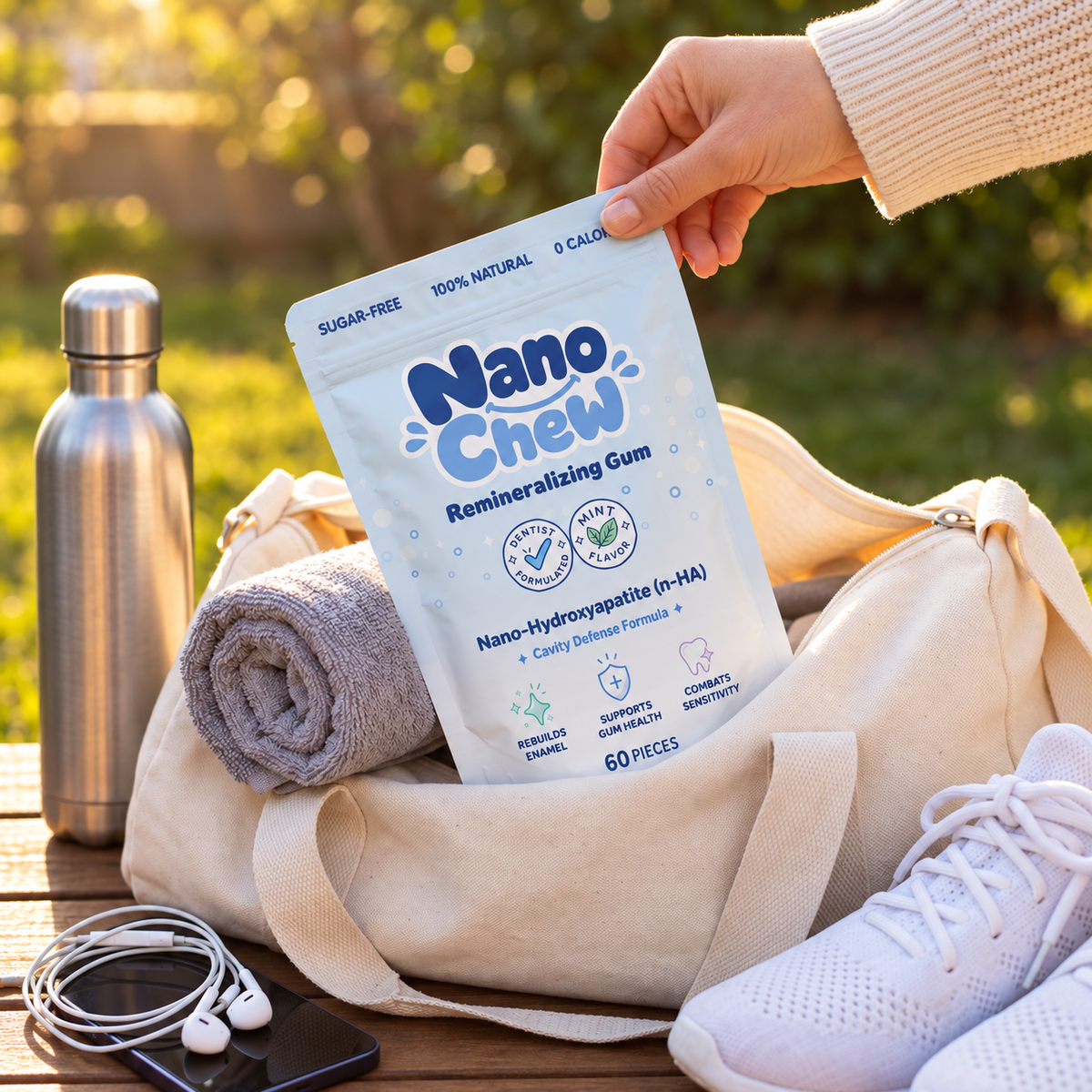
Make it automatic. Keep a pouch wherever you usually finish eating: your desk drawer, your car, your bag. The easiest habit is the one you never have to remember to plan.
Why snacking all day changes the math
How often you eat can matter as much as what you eat. Every snack or sweet sip starts a new acid cycle, and each cycle takes time to recover from.
Dental hygiene educators illustrate it this way: eat a cookie in a few minutes, and your teeth spend around 40 minutes in the acid zone. Eat the same cookie in four bites spread an hour apart, and that becomes about 160 minutes of acid exposure. Same cookie, four times the time spent losing minerals.
If you're a grazer, two changes help most:
- Group snacks together instead of nibbling all afternoon.
- Close each eating session with a piece of NanoChew to help your mouth recover faster.
5 common mistakes with remineralizing gum
- Spitting it out too soon. Five minutes freshens your breath; 20–30 minutes supports your enamel.
- Only chewing in the morning. Lunch and dinner are often your biggest acid moments. Spread your pieces across the day.
- Chewing before meals instead of after. The recovery window starts when you finish eating.
- Using it instead of brushing. Remineralizing gum adds to brushing and flossing. It doesn't replace them.
- Stopping after a week. Enamel support is built on consistency. Give it 3+ months.
Can you chew too much remineralizing gum?
Stick to 2–3 pieces a day. That's all you need, and there are two reasons not to go overboard.
Sugar alcohols. Xylitol and erythritol are tooth-friendly sweeteners, but very large amounts of sugar alcohols can upset your stomach. In a randomized, double-blind study, digestive effects showed up at single doses of 35–50 grams of xylitol, while erythritol was far better tolerated. A few pieces of gum a day are nowhere near those amounts, which is one reason NanoChew pairs xylitol with erythritol. See the full ingredient list.
Your jaw. The ADA notes that intense, extended gum chewing can lead to jaw pain and headaches. 2–3 pieces spread across the day keeps things comfortable.
Who should check with a dentist first
- People with TMJ or jaw pain. The ADA advises avoiding gum if you have a TMJ disorder.
- People with braces or other orthodontic appliances. Ask your orthodontist whether gum is okay for your appliance.
- People with dentures, bridges or recent dental work. Check that chewing gum won't stick to or stress your restorations.
- Young children. Gum isn't recommended for young kids because of the choking risk. For older kids and teens, check with your dentist.
- Pregnant or nursing. Run any new daily product by your dentist or doctor.
And for everyone with a dog at home: xylitol is toxic to dogs, even in small amounts, according to the FDA. Keep your pouch out of reach.
What to expect with consistent use
Enamel support builds over time, which is why NanoChew is designed for daily use over 3+ months. Some benefits can show up sooner. For sensitivity specifically, a double-blind clinical study found that a hydroxyapatite gum significantly reduced tooth sensitivity within one to two weeks. Read more about remineralizing gum for sensitive teeth.
Fresher breath after meals is the benefit most people notice first, and it's a good reminder to keep the habit going.
FAQ
How often should you chew remineralizing gum?
2–3 times a day, after meals, for 20–30 minutes each time.
What is the best time to chew remineralizing gum?
Right after you finish eating or drinking something sugary or acidic. That's when your mouth is most acidic and your enamel is ready to recover.
Can I chew NanoChew after coffee?
Yes. Coffee with sugar or milk is one of the most common daily acid moments, so chewing a piece afterward is a smart use of one of your daily pieces.
Should I chew gum or brush right after eating?
After acidic foods, chew first. The ADA recommends waiting about an hour before brushing, and chewing sugar-free gum in that window helps saliva do its job.
Is chewing gum before bed okay?
Brushing and flossing should be the last thing you do before bed. If you have an evening snack, chew a piece afterward, then brush before you sleep.
How long until I notice a difference?
Use NanoChew daily for 3+ months for best results. For sensitivity, a hydroxyapatite gum showed significant improvement within one to two weeks in a clinical study.
Should I swallow the gum?
No. Chew each piece for 20–30 minutes, then throw it away.
Does remineralizing gum replace brushing?
No. Brush twice a day, floss daily and see your dentist regularly. NanoChew covers the hours in between.
How is remineralizing gum different from regular sugar-free gum?
Both boost saliva. Remineralizing gum also delivers nano-hydroxyapatite to support your enamel. See the full comparison.
Is nano-hydroxyapatite safe to chew every day?
Yes. The EU's Scientific Committee on Consumer Safety found no mutagenic, cytotoxic or inflammatory effects in its 2025 review. Read the full safety breakdown.
Make it a daily habit
Three pieces, three meals, 20–30 minutes each. That's the whole routine, and it covers the hours your toothbrush never reaches.
These statements have not been evaluated by the FDA. NanoChew is not intended to diagnose, treat, cure, or prevent any disease and is not a substitute for regular dental care.
Sources
- American Dental Association, MouthHealthy. "Chewing Gum." mouthhealthy.org
- American Dental Association, MouthHealthy. "Dietary Acids and Your Teeth." mouthhealthy.org
- Associated Press. "Dental group: sugar-free gum prevents cavities, strengthens teeth" (ADA Seal of Acceptance review of 20-minute, three-times-daily after-meal chewing). 2007. Fox News / AP
- Dentalcare.com. "Stephan Curve." Caries Process, Prevention and Management: The Diet (continuing education course). dentalcare.com
- Dimensions of Dental Hygiene. "The Role of Nutrition in Dental Caries." 2024. dimensionsofdentalhygiene.com
- Reddy A, Norris DF, Momeni SS, Waldo B, Ruby JD. "The pH of beverages in the United States." J Am Dent Assoc. 2016;147(4):255–263. PMC
- Storey D, Lee A, Bornet F, Brouns F. "Gastrointestinal tolerance of erythritol and xylitol ingested in a liquid." Randomized, double-blind, placebo-controlled study. Maastricht University
- Porciani PF, Chazine M, Grandini S. "A clinical study of the efficacy of a new chewing gum containing calcium hydroxyapatite in reducing dentin hypersensitivity." J Clin Dent. 2014;25(2):32–36. PubMed
- European Commission, Scientific Committee on Consumer Safety. "Scientific Opinion on Hydroxyapatite (nano), Submission IV." SCCS/1677/25, 2025. European Commission
- U.S. Food and Drug Administration. "Paws Off Xylitol; It's Dangerous for Dogs." fda.gov