

If you're comparing NanoChew and Larineco, you're shopping in a category that barely existed three years ago. Both are remineralizing gums. Both list nano-hydroxyapatite. Both say sugar-free, plastic-free, no aspartame.
The labels look interchangeable. They aren't. One of these formulas carries an antibacterial layer with its own clinical literature, and the other doesn't. One costs a third less per piece. This article walks through the science first, then the head-to-head, with every claim sourced.
Quick Answer
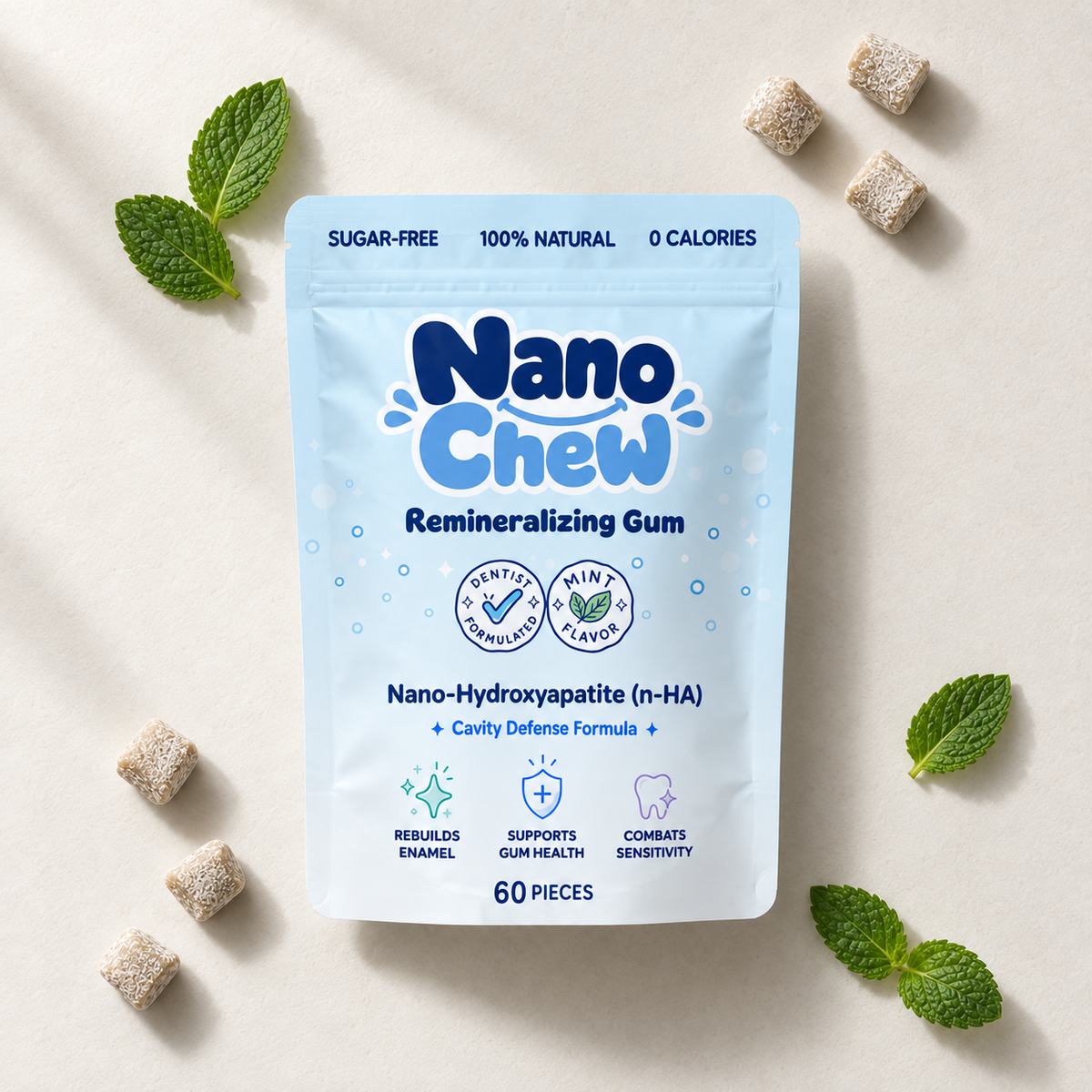
NanoChew is the stronger daily choice. Both gums share a nano-hydroxyapatite, xylitol, erythritol, mastic, bentonite clay and eggshell powder foundation. NanoChew adds natural propolis, coconut oil, activated charcoal and natural calcium on top of it, is dentist-formulated with 500+ five-star reviews, and costs $0.50 per piece in a 60-piece pouch versus roughly $0.67 for Larineco's 36-count. Propolis is the difference that matters most: it carries antibacterial and antiplaque evidence, including a 2025 trial testing it in chewing gum form, that Larineco's formula doesn't replicate.
Last updated: September 2026 · Ingredient and price data confirmed from current listings, September 2026 · Research sourced from peer-reviewed literature
Key takeaways
- Enamel loses minerals after every meal; gum works in the 30–60 minute window when it's recovering
- Nano-hydroxyapatite has matched fluoride toothpaste for cavity prevention in clinical trials
- NanoChew: 13 ingredients including propolis, coconut oil, activated charcoal and natural calcium
- Larineco: 11 ingredients, no propolis, no coconut oil, no charcoal
- NanoChew is $0.50 per piece; Larineco's 36-count is about $0.67, a difference of roughly $187 a year
- NanoChew's guidance is 20–30 minutes per piece, the window the clinical trials used
In this article
- What actually happens to your enamel after you eat
- Nano-hydroxyapatite: the mineral both gums are built on
- What the clinical evidence shows
- At a glance
- The shared foundation
- Propolis: the biggest formula gap
- NanoChew's other additions
- Larineco's base additions
- Formula depth, side by side
- Value per piece
- Usage instructions: an overlooked difference
- Flavor, texture and sticking with it
- The verdict
- FAQ
- Sources
What actually happens to your enamel after you eat
Dentists describe it with a graph called the Stephan curve, and it explains this entire product category.
When you eat sugars or starches, bacteria in plaque ferment them into acid within minutes. The pH at your tooth surface drops below about 5.5, the "critical pH" at which enamel starts dissolving. While it stays down there, your enamel is losing calcium and phosphate. Saliva then buffers the acid and brings the pH back up, and minerals move back into the enamel surface. That recovery typically takes 30 to 60 minutes.
Acidic drinks skip the bacteria and go straight to the damage. In a study published in the Journal of the American Dental Association, researchers tested 380 beverages sold in US stores and found 93% had a pH below 4.0, well into the erosive range. That includes sugar-free sodas, sports drinks, citrus juice and wine.
So the average person runs this cycle three to six times a day, and brushes for two of those minutes, usually at times that don't line up with any of them.
Chewing changes the recovery side of the curve. Resting saliva flow is about 0.3–0.4 mL per minute. Chewing gum base alone raises flow 10 to 12 times, and stimulated saliva is richer in calcium, phosphate and hydroxide ions, the exact building blocks of enamel mineral. That's why the American Dental Association states that chewing sugarless gum for 20 minutes after meals can help prevent tooth decay.
A remineralizing gum adds the finished mineral to that environment instead of relying on saliva alone.
Nano-hydroxyapatite: the mineral both gums are built on
Hydroxyapatite is a calcium-phosphate mineral, and it makes up roughly 97% of your tooth enamel. Your enamel is built from hydroxyapatite crystals around 20–40 nanometres in size.
Nano-hydroxyapatite (n-HA) is that same mineral manufactured at that same scale. The size is the point: particles in the tens of nanometres can settle into the microscopic surface defects left by acid attack, while conventional, far larger hydroxyapatite particles mostly sit on the surface and polish.
This is why researchers call n-HA biomimetic. It isn't a drug that changes your teeth's chemistry. It's the material your teeth are already made of.
It also isn't new. Japan recognized hydroxyapatite as an anti-cavity agent in 1993, and the ingredient has been in daily use in Japanese oral care ever since. In 2025, the EU's Scientific Committee on Consumer Safety reviewed nano-hydroxyapatite and found no mutagenic, cytotoxic or inflammatory effects, with negligible uptake through the lining of the mouth. Full safety breakdown here.
What the clinical evidence shows
Both gums rest on this body of research, so it's worth knowing what it actually says.
- Cavity prevention. A 2024 systematic review and meta-analysis in the Journal of Dentistry concluded hydroxyapatite is clinically non-inferior to fluoride toothpaste for caries prevention, drawing on randomized controlled trials including an 18-month double-blind study in adults against 1,450 ppm fluoride.
- Remineralization of early lesions. In a randomized, double-blind study at UT Health San Antonio, 30 adults wore intraoral appliances carrying enamel samples. Over 28-day phases, 5% and 10% nano-hydroxyapatite formulas and an 1,100 ppm fluoride toothpaste all significantly reduced mineral loss and lesion depth, with no significant difference in mineral gain among them.
- Sensitivity. A 2023 meta-analysis of 44 clinical trials found hydroxyapatite outperformed placebo by nearly 40% and fluoride toothpastes by about 23% for dentin hypersensitivity.
- In gum form specifically. In a double-blind study of 107 people, a sugar-free gum containing hydroxyapatite produced statistically significant improvement across every sensitivity measure after one and two weeks, and significantly outperformed an identical placebo gum.
That last study is the one that matters for this comparison: the mineral has been tested in the delivery format both of these products use.
At a glance
| Criterion | NanoChew | Larineco |
|---|---|---|
| Price per piece | $0.50 (60 pieces, $29.99) | About $0.67 (36 ct, $23.99) |
| Cost per year at 3/day | About $547 | About $734 |
| Pieces per pouch | 60 (20–30 days) | 36 (12–18 days) |
| Nano-hydroxyapatite | Yes | Yes |
| Xylitol + erythritol | Yes, both organic | Yes |
| Mastic gum | Yes, organic | Yes |
| Natural propolis | Yes | No |
| Coconut oil | Yes | No |
| Activated charcoal | Yes | No |
| Natural calcium | Yes | No |
| Eggshell powder + bentonite clay | Yes | Yes |
| Sugar / aspartame / dyes | None | None |
| Chew-time guidance | 20–30 minutes, 2–3 pieces daily | Listing says chew until the flavor fades |
| Dentist-formulated | Yes | Not stated |
| Reviews | 500+ five-star | Amazon-only presence |
| Vegan | No (eggshell powder) | No (eggshell powder) |
The shared foundation
Both formulas get the basics right, and it's worth understanding what those basics do.
Nano-hydroxyapatite
Covered above. Both brands use the nano form rather than conventional hydroxyapatite, which is the correct call.
Xylitol
Xylitol is the most-studied sweetener in preventive dentistry. Cavity-causing Streptococcus mutans takes xylitol up but can't metabolize it, which drains the bacterium's energy rather than feeding it. A 2025 systematic review in BMC Oral Health by Söderling and Pienihäkkinen found that in 12 of 14 studies, xylitol gum significantly decreased mutans streptococci counts compared with sorbitol gum. Plaque accumulation fell in 6 of 10 studies, and caries occurrence in 3 of 5 trials.
Both gums use it. NanoChew's is organic.
Erythritol
The second polyol in both formulas. It adds sweetness with a cooling finish and is notably gentle on digestion compared with other sugar alcohols, which matters when you're chewing several pieces a day.
Mastic gum
The resin of Pistacia lentiscus, used in Mediterranean oral care for centuries and studied in modern dentistry. A pilot study in the Journal of Periodontology examined the antiplaque effects of mastic chewing gum in the oral cavity. Both gums include it; NanoChew's is organic.
Calcium bentonite clay and organic eggshell powder
Both formulas carry both. A 2026 systematic review and meta-analysis in Odontology, covering 17 in vitro studies of extracted human and bovine teeth, found eggshell extract significantly improved enamel microhardness and reduced surface roughness, with the calcium-to-phosphate ratio of treated enamel also improving. The authors noted results comparable to fluoride varnish and nano-hydroxyapatite. That's laboratory evidence rather than clinical, and it should be read that way, but it's a real reason the ingredient is in both products.
So far, an even match. Here's where they separate.
Propolis: the biggest formula gap
NanoChew contains natural propolis. Larineco's ingredient panel does not list it.
Propolis is the resin honeybees produce from plant sources to seal and sterilize the hive. It carries hundreds of bioactive compounds, including flavonoids and phenolic acids, with documented antimicrobial, anti-inflammatory and anti-biofilm activity. In oral care, it's one of the more heavily researched natural actives of the last decade.
What the research shows:
- A 2025 systematic review and meta-analysis in the Journal of Functional Biomaterials, registered with PROSPERO and covering seven randomized controlled trials, found propolis formulations significantly reduced plaque index scores.
- A 2025 systematic review in BDJ Open examined propolis for gingivitis and periodontitis across six databases, including PubMed, Cochrane CENTRAL and Europe PMC.
- A 2024 randomized controlled trial in BMC Complementary Medicine and Therapies compared propolis directly against chlorhexidine, the clinical benchmark antiseptic in periodontics, in gingivitis patients.
- Most relevant here, a 2025 clinical trial in BMC Oral Health tested propolis in chewing gum form, with participants chewing for 20 minutes three times a day after meals, measuring plaque index, gingival index and papillary bleeding index before and after.
Why the delivery format matters. A mouth rinse contacts your tissue for 30 to 60 seconds. A piece of gum chewed for 20 to 30 minutes keeps its actives working for the entire post-meal window, the same window when acid is attacking enamel and plaque is reorganizing. That's the case for putting an antibacterial ingredient in gum rather than a bottle.
Larineco's formula relies on xylitol and mastic for its antibacterial coverage. NanoChew has both of those, and propolis on top. See the complete NanoChew ingredient list.
NanoChew's other additions
Coconut oil
Coconut oil is roughly half lauric acid, the fatty acid behind its long traditional use in oral care. In NanoChew it also softens the chew, which is part of why the gum stays pleasant through a full 20–30 minute session rather than turning stiff.
Activated charcoal
Highly porous carbon with an enormous surface area, included for the clean mouthfeel it contributes during chewing. Larineco's formula has no equivalent.
Natural calcium
An additional calcium source alongside the nano-hydroxyapatite and eggshell powder. Remineralization is a calcium-and-phosphate process, and saliva delivers those ions too; more available calcium in the chewing window is the logic here.
Organic terpene blend
Menthone, carvone and cineol, at under 1%. Cineol (eucalyptol) in particular has documented antimicrobial properties in oral care research, so this blend is doing more than flavoring. Larineco's panel also lists a natural terpene blend.
Larineco's base additions
Larineco's formula adds three resins NanoChew doesn't use: spruce sap, myrrh and acacia gum.
All three have long histories. Spruce resin was chewed in North America long before commercial gum existed. Myrrh appears in traditional oral remedies across the ancient world. Acacia gum is a common food-grade binder.
The honest assessment: their clinical evidence base in oral health is considerably thinner than mastic's, and far thinner than propolis's. They change the character of the chew more than they change what the gum does for your teeth. That's a reasonable formulation choice, just a different one from spending that space on an active with randomized-trial support.
Formula depth, side by side
| Ingredient | Role | NanoChew | Larineco |
|---|---|---|---|
| Nano-hydroxyapatite | Enamel mineral | ✅ | ✅ |
| Xylitol | Sweetener, anti-bacterial | ✅ organic | ✅ |
| Erythritol | Sweetener | ✅ organic | ✅ organic |
| Chicle | Natural base | ✅ organic | ✅ organic |
| Mastic | Base, studied in oral care | ✅ organic | ✅ |
| Propolis | Antibacterial, antiplaque | ✅ | ❌ |
| Coconut oil | Lauric acid, softer chew | ✅ | ❌ |
| Activated charcoal | Clean mouthfeel | ✅ | ❌ |
| Natural calcium | Extra calcium source | ✅ | ❌ |
| Eggshell powder | Calcium, mild polish | ✅ organic | ✅ organic |
| Bentonite clay | Minerals, mild polish | ✅ | ✅ |
| Terpene blend | Flavor, cineol activity | ✅ organic | ✅ |
| Spruce, myrrh, acacia | Base character | ❌ | ✅ |
Four actives in NanoChew have no counterpart in Larineco's panel. One of them, propolis, has randomized-trial evidence behind it, including a trial in gum format.
Try NanoChew — 60 pieces, $29.99 →
Value per piece
This is a daily habit at 2–3 pieces a day, so cost per piece is the number that decides what you're actually signing up for.
| Per piece | Per month at 3/day | Per year at 3/day | |
|---|---|---|---|
| NanoChew, 60 pieces, $29.99 | $0.50 | About $46 | About $547 |
| Larineco, 36 ct, $23.99 | About $0.67 | About $61 | About $734 |
About $187 a year, for the formula with fewer actives. The lower sticker price on the 36-count is the small-pack illusion: you pay less today and more per chew, and you reorder twice as often.
There's a practical angle too. A 60-piece pouch covers 20–30 days at the recommended amount, so one purchase covers a full month. A 36-count runs out in 12–18 days, which means two orders a month and twice the chance of a gap in the habit. Consistency is what this product depends on.
Larineco does list larger counts and runs Subscribe & Save coupons on Amazon, so check the current per-count price on whichever size you're considering.
Usage instructions: an overlooked difference
This is the difference almost nobody compares, and it changes what you get out of the product.
The clinical research uses a specific pattern. The ADA's guidance is 20 minutes of chewing after meals. The hydroxyapatite gum sensitivity trial and the propolis gum trial both used roughly 20 minutes, multiple times daily, after meals. NanoChew's instructions match that evidence: 2–3 pieces a day, 20–30 minutes each, after meals.
Larineco's Amazon listing directs users to chew the gum and dispose of it when the flavor fades. Flavor typically fades well before the 20-minute mark in any gum. A person following that instruction literally may be chewing for a fraction of the window the research is built on, and getting less from a product they paid for.
Whichever brand you buy, chew for at least 20 minutes after meals. Here's the full timing guide.
Flavor, texture and sticking with it
A 20–30 minute chew is a long time. If a gum turns tough, chalky or flavorless at minute eight, you stop early, and eventually you stop buying.
NanoChew is one flavor, natural and organic spearmint, tuned to stay soft and pleasant through the full window. The coconut oil in the formula is part of that: it keeps the chew supple where mineral-heavy gums often go dry and chalky.
Larineco offers more choices, including mastic mint, peppermint, cinnamon, berry and bubble gum. Variety is a legitimate reason some people stay consistent, and it's Larineco's clearest advantage.
The verdict
NanoChew is the stronger daily oral care product. Same mineral foundation, four additional actives including propolis with randomized-trial evidence behind it, 24 more pieces per pouch, about $187 a year cheaper at three pieces daily, dentist-formulated, 500+ five-star reviews, and usage instructions that match the clinical window the research used.
If flavor rotation is the thing that keeps you consistent, Larineco offers more of it, and consistency does matter. Everything else in this comparison favors NanoChew.
Neither gum is vegan; both contain eggshell powder. And neither replaces brushing, flossing or your dentist.
Start with one pouch — 60 pieces, $29.99 →
FAQ
Is NanoChew better than Larineco?
For most buyers, yes. Both share nano-hydroxyapatite, xylitol, erythritol, mastic, bentonite clay and eggshell powder. NanoChew adds propolis, coconut oil, activated charcoal and natural calcium, costs about $0.17 less per piece, and comes in a 60-piece pouch instead of 36.
What does propolis actually do?
It brings antibacterial and antiplaque activity. A 2025 PROSPERO-registered meta-analysis of seven randomized controlled trials found propolis significantly reduced plaque index scores, and a 2025 clinical trial tested propolis in chewing gum form specifically, chewed 20 minutes three times daily after meals.
Which is cheaper per piece?
NanoChew at $0.50, against about $0.67 for Larineco's 36-count as listed in September 2026. Over a year at three pieces a day, that's roughly $187.
How long should I chew each piece?
20–30 minutes. The ADA's guidance is 20 minutes after meals, and the hydroxyapatite and propolis gum trials used similar windows. Chewing only until the flavor fades is usually far shorter than that.
Do both use the same hydroxyapatite?
Both list nano-hydroxyapatite. Neither publishes particle size or concentration, which is standard in this category.
Is remineralizing gum as good as fluoride toothpaste?
A 2024 meta-analysis found hydroxyapatite clinically non-inferior to fluoride toothpaste for cavity prevention. But gum isn't a toothpaste replacement; it covers the hours between brushing. Full research summary.
Is nano-hydroxyapatite safe?
Yes. The EU's Scientific Committee on Consumer Safety reviewed it in 2025 and found no mutagenic, cytotoxic or inflammatory effects, with negligible uptake through the lining of the mouth. Japan has recognized hydroxyapatite as an anti-cavity agent since 1993.
Is either one vegan?
No. Both contain organic eggshell powder.
Can I chew these with braces or TMJ?
Ask your dentist or orthodontist first. The ADA advises people with TMJ disorders to avoid chewing gum.
How many pieces should I chew a day?
2–3 pieces, after meals, 20–30 minutes each. One 60-piece NanoChew pouch covers 20–30 days at that rate.
Where can I buy NanoChew?
On nanochewgum.com and Amazon. Larineco sells primarily through Amazon.
How is this different from regular sugar-free gum?
Regular gum gives you the saliva boost and nothing else. Remineralizing gum adds the enamel mineral itself. Full comparison here.
Bottom line
Larineco built a solid formula on the right foundation, and in a category still full of xylitol gum with a marketing budget, that counts for something.
But a daily habit deserves the deeper formula at the lower price. NanoChew brings the same nano-hydroxyapatite, xylitol, erythritol, mastic, clay and eggshell foundation, then adds propolis, coconut oil, activated charcoal and natural calcium, in a 60-piece pouch at $0.50 a piece, dentist-formulated, with 500+ five-star reviews and instructions that match what the research actually tested.
These statements have not been evaluated by the FDA. NanoChew is not intended to diagnose, treat, cure, or prevent any disease and is not a substitute for regular dental care. Competitor details come from that brand's own published listings as of September 2026 and may change.
Sources
- Pawinska M, Paszynska E, Amaechi BT, et al. "Clinical evidence of caries prevention by hydroxyapatite: an updated systematic review and meta-analysis." J Dent. 2024;151. ScienceDirect
- Paszynska E, Pawinska M, Enax J, et al. "Caries-preventing effect of a hydroxyapatite-toothpaste in adults: an 18-month double-blinded randomized clinical trial." Front Public Health. 2023;11:1199728. doi:10.3389/fpubh.2023.1199728
- Najibfard K, Ramalingam K, Chedjieu I, Amaechi BT. "Remineralization of early caries by a nano-hydroxyapatite dentifrice." J Clin Dent. 2011;22(5):139–143. PubMed
- Limeback H, Enax J, Meyer F. "Clinical evidence of biomimetic hydroxyapatite in oral care products for reducing dentin hypersensitivity: an updated systematic review and meta-analysis." Biomimetics. 2023;8(1):23. doi:10.3390/biomimetics8010023
- Porciani PF, Chazine M, Grandini S. "A clinical study of the efficacy of a new chewing gum containing calcium hydroxyapatite in reducing dentin hypersensitivity." J Clin Dent. 2014;25(2):32–36. PubMed
- Söderling E, Pienihäkkinen K. "Specific effects of xylitol chewing gum on mutans streptococci levels, plaque accumulation and caries occurrence: a systematic review." BMC Oral Health. 2025;25:1275. doi:10.1186/s12903-025-06602-1
- Sycińska-Dziarnowska M, Szyszka-Sommerfeld L, Bugajska M, et al. "Propolis as a natural remedy in reducing dental plaque and gingival inflammation: a systematic review and meta-analysis." J Funct Biomater. 2025;16(9):336. doi:10.3390/jfb16090336
- Khabazian A, Mirhashemi FS, Sadeghi F. "Investigating the effect of propolis-containing chewing gum in comparison with propolis-containing mouthwash on reducing gingival inflammation in patients with gingivitis." BMC Oral Health. 2025;25:231. doi:10.1186/s12903-025-05564-8
- Ballouk MAH, Altinawi M, Al-Kafri A, et al. "Propolis mouthwashes efficacy in managing gingivitis and periodontitis: a systematic review of the latest findings." BDJ Open. 2025;11:5. doi:10.1038/s41405-025-00294-z
- Gunjal S, Pateel DGS. "Comparative effectiveness of propolis with chlorhexidine mouthwash on gingivitis: a randomized controlled clinical study." BMC Complement Med Ther. 2024;24:154. doi:10.1186/s12906-024-04456-8
- "In vitro remineralization effectiveness of eggshell extract on human teeth: a systematic review and meta-analysis." Odontology. 2026;114(3):1057–1068. PubMed
- Takahashi K, Fukazawa M, Motohira H, et al. "A pilot study on antiplaque effects of mastic chewing gum in the oral cavity." J Periodontol. 2003;74:501–505. PubMed
- Reddy A, Norris DF, Momeni SS, Waldo B, Ruby JD. "The pH of beverages in the United States." J Am Dent Assoc. 2016;147(4):255–263. PMC
- American Dental Association. "Chewing Gum." Oral Health Topics. ada.org
- European Commission, Scientific Committee on Consumer Safety. "Scientific Opinion on Hydroxyapatite (nano), Submission IV." SCCS/1677/25, 2025. European Commission
- Larineco Sugar-Free Remineralizing Gum, 36 ct, Amazon listing (price, ingredient panel, pack sizes, usage directions), checked September 2026.