

If your mouth is always dry, you already know the discomfort. What most people don't know is the part that shows up years later at the dentist: dry mouth is one of the strongest cavity risk factors there is.
Saliva isn't just moisture. It's your mouth's repair system, delivering the calcium and phosphate that rebuild enamel after every meal. When saliva drops, that repair slows down and decay accelerates.
This guide covers why dry mouth wrecks teeth, what the evidence says actually helps, and how NanoChew is built to handle both halves of the problem: stimulating saliva and replacing the mineral your saliva can no longer supply.
Quick Answer
Chewing sugar-free gum is one of the standard recommendations for dry mouth, because chewing raises saliva flow 10–12 times over resting levels. But if you have dry mouth, you also have elevated cavity risk, so the better choice is a gum that supplies mineral as well as stimulating saliva. NanoChew pairs nano-hydroxyapatite, the mineral your enamel is made of, with organic xylitol, which cavity-causing bacteria can't feed on. Chew 2–3 pieces a day after meals, 20–30 minutes each.
Last updated: September 2026 · Research sourced from peer-reviewed literature, the American Dental Association and published clinical guidelines
Key takeaways
- More than 500 medications can cause dry mouth, and it's the third most common drug side effect
- Among people taking five or more medications, one study found 71% reported dry mouth
- Less saliva means less buffering and less mineral, which raises cavity and root-decay risk sharply
- Chewing stimulates saliva 10–12 fold, and sugar-free gum is recommended by the ADA for dry mouth relief
- Gum only works if you still have some salivary function; it stimulates flow rather than replacing it
- Skip acid-based lozenges and anything sugary; both make the enamel problem worse
In this article
- Why dry mouth is a dental emergency in slow motion
- What causes it
- What saliva actually does for your teeth
- Does chewing gum help dry mouth?
- Which gum to choose, and what to avoid
- Why NanoChew fits dry mouth specifically
- A dry-mouth routine that protects your teeth
- What gum can't do
- When to see a dentist or doctor
- FAQ
- Sources
Why dry mouth is a dental emergency in slow motion
Dry mouth, clinically called xerostomia, is uncomfortable day to day. The damage is quieter.
Because saliva buffers acid and carries the minerals that rebuild enamel, reduced saliva means significantly greater risk of dental caries and erosion. Root caries in particular becomes a problem, because exposed root surfaces have no enamel covering them at all. Dry mouth also raises the risk of bad breath, gum disease and oral thrush.
One periodontist put the stakes memorably: if saliva were only water, we'd have little stumps of teeth, or none at all, by age 20.
So if your mouth is dry, the top priority isn't comfort. It's protecting enamel that's now working without its usual defense system.
What causes dry mouth
Medication is the leading cause. More than 500 drugs across roughly 42 drug classes can cause dry mouth, and it ranks as the third most common side effect of medication overall. Common culprits include:
- Antidepressants and anti-anxiety medication
- Antihistamines and decongestants
- Blood pressure medication, diuretics and beta-blockers
- Pain medication, including opioids
- Bladder and muscle relaxants
- Antipsychotics and antiseizure drugs
The more medications, the higher the risk. In a primary-care study, overall dry-mouth prevalence was 43.6%, and among patients taking five or more medications it reached 71.2%. Estimates vary widely across populations, from under 1% to around 65%, with consistently higher rates in women and older adults.
Other common causes: autoimmune conditions like Sjögren's syndrome, head and neck radiation, chemotherapy, diabetes, mouth breathing and snoring, dehydration, stress and anxiety, and smoking.
Most people in that list can't stop the medication causing it. Which means the practical goal is managing the consequences, and protecting your teeth is the most consequential part.
What saliva actually does for your teeth
Every time you eat, plaque bacteria turn sugars and starches into acid, and the pH at your tooth surface drops below about 5.5, the point where enamel begins dissolving. Saliva then buffers that acid and carries calcium and phosphate back into the enamel. That recovery normally takes 30 to 60 minutes.
Healthy resting saliva flow is roughly 0.3–0.4 mL per minute. With dry mouth, that recovery either takes far longer or barely happens, so each meal does more damage than it would otherwise. It's the same acid attack everyone gets, without the cleanup crew.
Two things fix that math: getting whatever saliva you still produce flowing, and supplying the mineral your saliva would normally deliver.
Does chewing gum help dry mouth?
Yes, with an honest caveat worth understanding.
What's well established: chewing stimulates salivary flow to 10–12 times resting levels, with flavor pushing it higher. The ADA lists chewing sugar-free gum among the interventions that may alleviate xerostomia, and the 2021 ISOO/MASCC/ASCO clinical guideline on cancer-therapy-induced dry mouth includes sugar-free gum and lozenges among recommended interventions.
The caveat: a 2011 Cochrane review of topical dry-mouth therapies found that while chewing gum increased saliva production, there wasn't strong evidence that symptoms improved, and no single topical product stood out over another. Gum also only works if you have residual salivary function. It stimulates the glands you still have; it doesn't replace them.
Why we're telling you that: because the dental case for gum in dry mouth doesn't rest on symptom relief alone. It rests on cavity risk. You have elevated risk, saliva is the defense, and chewing is the simplest way to get more of it on demand, several times a day, without another prescription.
Which gum to choose, and what to avoid
Not every "dry mouth" product helps your teeth. Some actively hurt them.
| Option | Stimulates saliva? | Effect on enamel |
|---|---|---|
| Sugared mints or candy | ✅ | ❌ Feeds cavity bacteria, the worst option with dry mouth |
| Citric-acid lozenges and sour candies | ✅ strongly | ❌ The acid that triggers flow also erodes enamel |
| Sprays and gels | ❌ they moisten, not stimulate | Neutral, comfort only |
| Regular sugar-free gum | ✅ | Helpful, but supplies no mineral |
| NanoChew remineralizing gum | ✅ | ✅ Adds nano-hydroxyapatite and xylitol to the saliva boost |
Two rules for anything you put in a dry mouth: no sugar, because reduced saliva means less defense against the bacteria it feeds, and no acid, because acid-triggered saliva comes at the cost of the enamel you're trying to protect.
Why NanoChew fits dry mouth specifically
Dry mouth is a two-part problem: not enough saliva, and therefore not enough mineral reaching your teeth. NanoChew addresses both in the same 20–30 minutes.
- Nano-hydroxyapatite. The calcium-phosphate mineral that makes up roughly 97% of enamel, supplied directly rather than depending on saliva to carry it. A 2024 systematic review and meta-analysis found hydroxyapatite clinically non-inferior to fluoride toothpaste for cavity prevention, and a 2023 meta-analysis of 44 trials found it reduced sensitivity by nearly 40% versus placebo. In gum form, a double-blind study of 107 people found significant sensitivity improvement within one to two weeks.
- Organic xylitol. Cavity-causing Streptococcus mutans takes xylitol up but can't metabolize it. A 2025 systematic review in BMC Oral Health found xylitol gum significantly lowered mutans streptococci counts in 12 of 14 studies compared with sorbitol gum. For a mouth with reduced natural defenses, a sweetener that starves the bacteria instead of feeding them matters more, not less.
- Natural propolis. A 2025 PROSPERO-registered meta-analysis of seven randomized controlled trials found propolis formulations significantly reduced plaque scores, and a 2025 clinical trial tested propolis in chewing gum form, chewed 20 minutes three times daily after meals. Dry mouth raises gum-disease risk too, so an antibacterial layer earns its place.
- No sugar, no acid, no aspartame. Sweetened with organic xylitol and organic erythritol, with zero calories.
- A soft chew that lasts. Coconut oil in the formula keeps the gum supple through a full 20–30 minute session, which matters when your mouth is already dry and a stiff chew becomes unpleasant fast.
- An organic chicle-and-mastic base, not the unnamed synthetic base on most labels.
Dentist-formulated, 500+ five-star reviews, 60 pieces for $29.99, which is $0.50 a piece and 20–30 days of daily use. Every ingredient is published here.
Try NanoChew — 60 pieces, $29.99 →
A dry-mouth routine that protects your teeth
- Chew NanoChew after every meal. 2–3 pieces a day, 20–30 minutes each. This is when acid is highest and your saliva is least able to cope. Full timing guide.
- Sip water through the day. Frequent small sips beat occasional large ones for comfort.
- Cut acidic and sugary drinks. In a Journal of the American Dental Association study, 93% of 380 US beverages tested below pH 4.0, in the erosive range. With low saliva, there's little to neutralize them.
- Brush gently twice daily with a mineral toothpaste, hydroxyapatite or fluoride, and floss.
- Ask your doctor about your medications. Sometimes a dose change or a switch reduces dryness. Never stop a medication on your own.
- Ask your dentist about more frequent checkups. Dry mouth is a recognized high-caries-risk condition, and many dentists shorten the recall interval for it.
- Use a humidifier at night if you wake up dry, especially if you breathe through your mouth.
What gum can't do
Straight answers, because overselling this helps nobody:
- Gum doesn't restore salivary gland function. It stimulates whatever function remains. If your glands are severely damaged by radiation or advanced Sjögren's, you may need saliva substitutes or prescription medication, and that's a conversation with your dentist or doctor.
- It isn't a cure for the underlying cause. Medication, autoimmune disease, radiation: those need medical management.
- It doesn't replace brushing or dental visits. With dry mouth, those matter more than ever.
- Avoid gum if you have a TMJ disorder. The ADA advises against chewing gum in that case, and lozenges may suit better. Chewing can also be difficult with dentures or arthritis.
When to see a dentist or doctor
- Dry mouth lasting more than a few weeks
- New white spots, dark spots, or cavities appearing faster than before
- Decay at the gumline or on root surfaces
- Burning or soreness in the mouth, or white patches suggesting thrush
- Difficulty swallowing or speaking
- Dry eyes along with dry mouth, which can point to Sjögren's syndrome
FAQ
What is the best gum for dry mouth?
A sugar-free, acid-free gum that also supplies mineral, because dry mouth raises cavity risk. NanoChew combines nano-hydroxyapatite with organic xylitol and erythritol in an organic chicle-and-mastic base, 60 pieces for $29.99. Start with one pouch.
Does chewing gum help dry mouth?
Chewing raises saliva flow 10–12 times over resting levels, and the ADA lists sugar-free gum among the interventions that may alleviate dry mouth. A 2011 Cochrane review found no strong evidence that any topical therapy improves symptoms, though gum did increase saliva production. It works only if you still have some salivary function.
Why does dry mouth cause cavities?
Saliva buffers acid and delivers the calcium and phosphate that rebuild enamel after meals. With less saliva, acid lingers and enamel doesn't recover, which sharply raises the risk of caries, especially root caries.
Is xylitol gum good for dry mouth?
Yes. It stimulates saliva without feeding cavity bacteria, and xylitol gum significantly lowered mutans streptococci counts in 12 of 14 studies compared with sorbitol gum.
What medications cause dry mouth?
More than 500, including antidepressants, antihistamines, blood pressure medication, diuretics, opioids, bladder medication and antipsychotics. Never stop a prescription on your own; ask your doctor whether an alternative is available.
How often should I chew gum for dry mouth?
2–3 pieces a day after meals, 20–30 minutes each. If dryness is constant, you can chew more often, but keep to the package directions for daily amounts.
Is remineralizing gum better than regular sugar-free gum for dry mouth?
For your teeth, yes. Both stimulate saliva, but only remineralizing gum supplies the mineral your reduced saliva can't. Full comparison.
Can dry mouth be cured?
It depends on the cause. Medication-related dryness can improve with a change your doctor approves. Gland damage from radiation or autoimmune disease is usually managed rather than cured, which makes protecting your teeth the long game.
Is nano-hydroxyapatite safe to use daily?
Yes. The EU's Scientific Committee on Consumer Safety reviewed it in 2025 and found no mutagenic, cytotoxic or inflammatory effects. Full safety breakdown.
Should I use a dry mouth spray as well?
You can. Sprays and gels moisten without stimulating flow, so they're for comfort. Gum handles the saliva and mineral side. They solve different halves of the problem.
Bottom line
Dry mouth takes away the system that repairs your teeth several times a day. You can't always fix the cause, but you can give your mouth the two things it's missing: more saliva, and the mineral that saliva normally delivers.
That's a piece of NanoChew after each meal. Sugar-free, acid-free, and built around the mineral your enamel is made of.
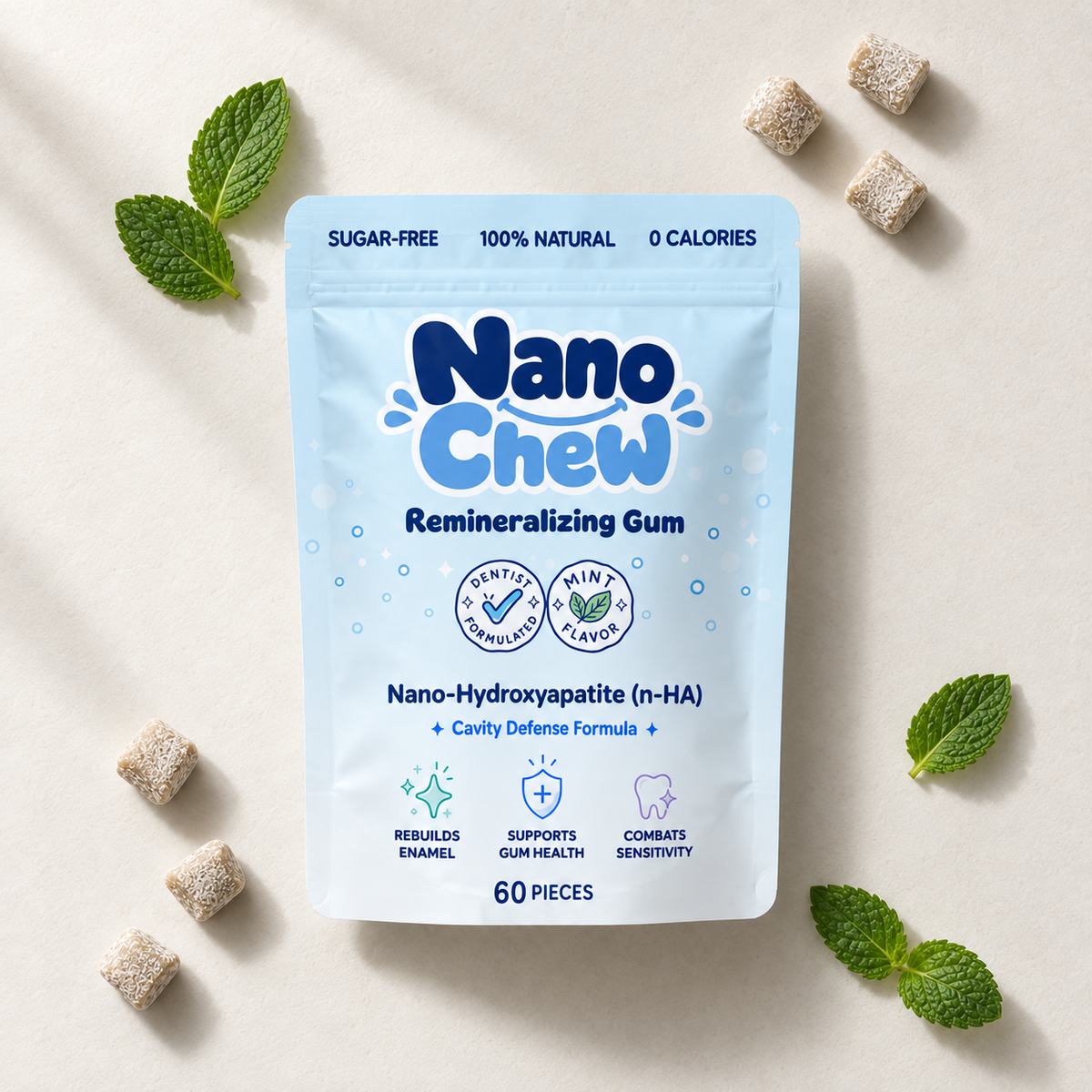
Shop NanoChew — 60 pieces, $29.99 →
These statements have not been evaluated by the FDA. NanoChew is not intended to diagnose, treat, cure, or prevent any disease and is not a substitute for regular dental or medical care. If dry mouth persists, speak with your dentist or doctor.
Sources
- American Dental Association. "Xerostomia (Dry Mouth)." Oral Health Topics. ada.org
- American Dental Association. "Chewing Gum." Oral Health Topics. ada.org
- Mercadante V, Jensen SB, Smith DK, et al. "Salivary Gland Hypofunction and/or Xerostomia Induced by Nonsurgical Cancer Therapies: ISOO/MASCC/ASCO Guideline." J Clin Oncol. 2021;39(25):2825–2843.
- Furness S, Worthington HV, Bryan G, Birchenough S, McMillan R. "Interventions for the management of dry mouth: topical therapies." Cochrane Database of Systematic Reviews. 2011.
- Hopcraft M, et al. Xerostomia prevalence and medication use in primary care. Acta Odontologica Scandinavica. medicaljournalssweden.se
- Colgate Professional. "Medication-Induced Xerostomia and Caries Risk." colgateprofessional.com
- Pawinska M, Paszynska E, Amaechi BT, et al. "Clinical evidence of caries prevention by hydroxyapatite: an updated systematic review and meta-analysis." J Dent. 2024;151. ScienceDirect
- Limeback H, Enax J, Meyer F. "Clinical evidence of biomimetic hydroxyapatite in oral care products for reducing dentin hypersensitivity: an updated systematic review and meta-analysis." Biomimetics. 2023;8(1):23. doi:10.3390/biomimetics8010023
- Porciani PF, Chazine M, Grandini S. "A clinical study of the efficacy of a new chewing gum containing calcium hydroxyapatite in reducing dentin hypersensitivity." J Clin Dent. 2014;25(2):32–36. PubMed
- Söderling E, Pienihäkkinen K. "Specific effects of xylitol chewing gum on mutans streptococci levels, plaque accumulation and caries occurrence: a systematic review." BMC Oral Health. 2025;25:1275. doi:10.1186/s12903-025-06602-1
- Sycińska-Dziarnowska M, et al. "Propolis as a natural remedy in reducing dental plaque and gingival inflammation: a systematic review and meta-analysis." J Funct Biomater. 2025;16(9):336. doi:10.3390/jfb16090336
- Khabazian A, Mirhashemi FS, Sadeghi F. "Investigating the effect of propolis-containing chewing gum in comparison with propolis-containing mouthwash on reducing gingival inflammation in patients with gingivitis." BMC Oral Health. 2025;25:231. doi:10.1186/s12903-025-05564-8
- Reddy A, Norris DF, Momeni SS, Waldo B, Ruby JD. "The pH of beverages in the United States." J Am Dent Assoc. 2016;147(4):255–263. PMC
- European Commission, Scientific Committee on Consumer Safety. "Scientific Opinion on Hydroxyapatite (nano), Submission IV." SCCS/1677/25, 2025. European Commission